 Mobile App Development
 Artificial Intelligence
 Software Development
 Generative AI
 QA & Testing
 UI/ UX Design
 IoT App Development
 Cloud App Development
 MVP Development
 SEO Services
 AI Code Optimization
 AI Integration Services
 Food Delivery
 Taxi Booking
 E-Commerce
 Mobile Game
 Logistics
 Real Estate
 Healthcare
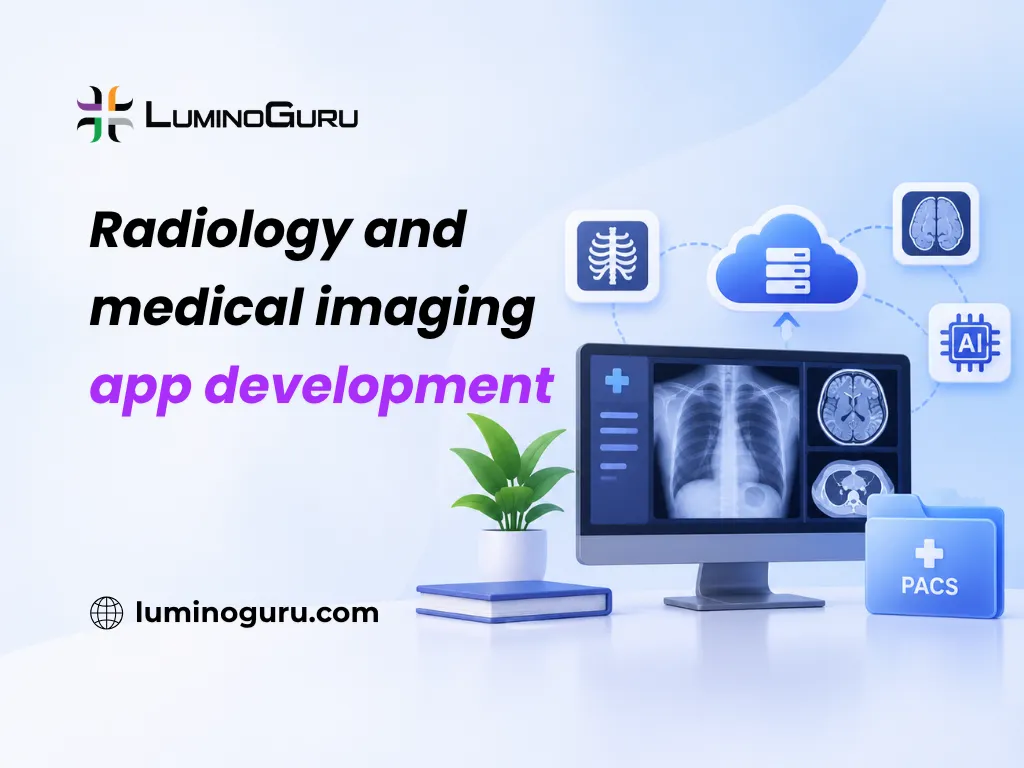
Radiology app development means building a DICOM viewer that connects to a hospital’s PACS, so clinicians can view, share and analyse CT, MRI, X-ray and other scans on mobile or web. The build decisions that matter most are regulatory classification, PACS integration method, and how AI findings are displayed.
Mobile image viewing changed radiology, but most guides on this topic are a list of app names rather than a build guide. This one covers how these apps actually work, current 2026 market and FDA data, what PACS integration really involves, and realistic costs.
What does a radiology or medical imaging app actually do?
A radiology app lets clinicians view, share and analyse DICOM images such as X-rays, CT, MRI and ultrasound on a phone, tablet or browser, usually pulling from a hospital’s PACS. Most also route AI findings, like a flagged bleed or fracture, into the same viewer so a radiologist sees them alongside the image.
The viewer is one small piece of a much bigger system: a PACS or VNA that stores images, a RIS that manages orders and reports, and increasingly an AI layer that triages the worklist before a human looks at anything.
How big is AI in radiology right now, and is it still growing?
Very big, and still growing fast. Radiology accounts for the large majority of all FDA-cleared AI medical devices, and the specialty PACS and imaging IT market is worth several billion dollars.
The FDA’s AI-enabled medical device list held 1,524 cleared algorithms as of 30 March 2026, and 1,163 of them, about 76%, were for radiology, according to Radiology Business’s count of the FDA’s own list. Mordor Intelligence sizes the specialty PACS market at $2.95 billion in 2026, growing to $4.07 billion by 2031, a 6.64% CAGR. These are two different numbers for two different things, the AI layer and the imaging infrastructure underneath it, so don’t merge them into one claim.
Aidoc and Viz.ai are the two most widely deployed pure-play radiology AI vendors by clearance count, according to a March 2026 vendor landscape from The Imaging Wire. That matters for anyone planning integrations, since most hospital PACS systems already route to one or both.
Also Read: How to hire an AI developer
What should you check before building a mobile radiology viewer?
Confirm what the app is for, since diagnosis and review are regulated differently from simple convenience viewing, and get that classification right before you design a single screen.
| Question | Why it matters |
|---|---|
| Is this a diagnostic viewer or a review and sharing tool? | A diagnostic viewer is typically FDA Class II medical device software under 21 CFR 892.2050 and needs 510(k) clearance in the US. A tool only for sharing or review after diagnosis has lighter requirements |
| Where does PHI live, and for how long? | Most mobile viewers cache a copy locally and delete it after a set window, often 24 to 48 hours, rather than storing images permanently on the device |
| Which PACS or VNA will it connect to? | Integration method (DICOMweb, a vendor SDK, or a proxy server) depends entirely on what the hospital already runs |
| Does it need to work on a locked-down hospital network? | Clinical WiFi and VPN rules often block consumer-grade apps that weren’t designed for them |
| Will AI findings display inside the viewer? | If so, confirm whether you are consuming an existing FDA-cleared algorithm’s output or displaying your own, since the regulatory bar differs |
Mobile diagnostic reading is not simply the desktop app on a smaller screen. Regulators and hospitals both treat a phone or tablet used for primary diagnosis as a different risk category, since screen calibration, ambient lighting and display consistency affect whether a radiologist can trust what they see.
What features does a radiology app need?
A clinical imaging app needs four groups of features: viewing, collaboration, worklist and AI integration, security and compliance. Skipping any one of them to ship faster usually shows up as a support problem within weeks of launch.
| Area | Core features |
|---|---|
| Viewing | Multi-modality support (CT, MRI, X-ray, ultrasound, PET), window and level adjustment, zoom and pan, multi-slice scroll, image fusion for combined modalities |
| Collaboration | Secure messaging tied to a specific study, annotation tools, second-opinion routing to another radiologist |
| Worklist and AI | A prioritised list that AI triage can reorder (for example, a suspected bleed moves to the top), confidence or finding labels shown clearly as assistive, not diagnostic, unless the algorithm is cleared for that use |
| Security and compliance | Encrypted transfer and storage, auto-expiring local caches, audit logs of who viewed which study and when, role-based access, a signed Business Associate Agreement with every vendor touching PHI |
Keep AI output visually distinct from the primary read. Several radiology groups have flagged that poorly labelled AI overlays create anchoring bias, where a radiologist’s eye goes straight to the AI’s suggestion instead of reading the image independently first.
How do you integrate a mobile app with hospital PACS?
Use DICOMweb (QIDO-RS, WADO-RS, STOW-RS) wherever the PACS supports it, since it’s the modern, vendor-neutral way to query, retrieve and store studies over HTTP. Fall back to a vendor-specific SDK, like Novarad’s or a similar PACS maker’s, only when DICOMweb isn’t available.
Older hospital PACS installations, and there are plenty still running, may only expose the classic DICOM network protocol (C-FIND, C-MOVE) rather than DICOMweb. In that case you need a gateway server that translates between the hospital’s network and your app, which adds a real piece of infrastructure and a real point of failure to plan around.
Whichever path you take, treat the PACS vendor relationship as its own project track. Integration approval, test environments and security review from a hospital’s IT and compliance teams routinely take longer than writing the viewer itself.
Also Read : Doctor on demand app development: how to plan, build and budget it
How much does a radiology or medical imaging app cost to build?
A simple viewing and sharing app with one PACS integration typically runs $40,000 to $90,000. A clinical-grade viewer with AI worklist integration, multiple PACS connectors and full compliance work runs $150,000 to $500,000 or more. These are planning estimates, not quotes.
| Scope | What it includes | Estimated cost | Timeline |
|---|---|---|---|
| Basic viewer | Single PACS integration, core viewing tools, secure sharing | $40,000 to $90,000 | 3 to 5 months |
| Mid-level platform | Multiple modalities, annotation, messaging, role-based access, one or two PACS connectors | $90,000 to $200,000 | 5 to 8 months |
| Enterprise, AI-integrated platform | AI worklist triage, multi-PACS and multi-site support, full FDA SaMD or MDR compliance architecture | $200,000 to $500,000+ | 9 to 15 months |
Regulatory classification, the number of imaging modalities you support, and the depth of EHR or PACS integration drive the price far more than screen count does. If you’re validating demand before a full build, our MVP development services can scope a narrow first version around one modality and one PACS.
What mistakes do teams make building radiology apps?
The most common is skipping the regulatory classification question until late, then discovering the app needs 510(k) clearance it was never designed for. Retrofitting compliance into an existing codebase costs far more than designing for it from the start.
A close second is underestimating the PACS integration timeline. Teams scope the viewer itself in weeks, then spend months waiting on a hospital’s IT department to approve network access and run a security review. Build that lag into your plan rather than your launch date.
Teams also sometimes display AI findings without making clear they’re assistive, not diagnostic, which creates both a liability problem and a trust problem once radiologists realise the app is quietly nudging their reads.
How Luminoguru can help build a radiology or imaging platform
Luminoguru is a global software and digital company with a team of more than 100 engineers, designers and project managers, building digital products since 2014. Our healthcare app development team scopes clinical imaging builds around your PACS environment and your regulatory path.
We usually start by confirming whether your app needs FDA SaMD classification or similar in your market, then scope the PACS integration and AI layer separately, since they’re different workstreams with different timelines.
We deliver from India, with a US office in California, and agree an overlap window with your team so you can work with us in real time.
Book a consultation and bring your PACS environment, modalities and regulatory questions with you.
Frequently asked questions
How much does it cost to build a radiology app?
A basic viewing and sharing app typically costs $40,000 to $90,000. A mid-level platform runs $90,000 to $200,000, and an enterprise AI-integrated platform can cost $200,000 to $500,000 or more. Regulatory classification and PACS integration depth drive the price most.
Does a mobile radiology viewer need FDA clearance?
It depends on its use. An app intended for primary diagnosis is typically FDA Class II medical device software under 21 CFR 892.2050 and needs 510(k) clearance. A tool used only for sharing or reviewing already-diagnosed images has lighter requirements. Confirm your intended use early.
What is the difference between PACS and a DICOM viewer?
A PACS is the backend system that stores, indexes and routes medical images across a hospital. A DICOM viewer is the application, often a separate mobile or web app, that displays images pulled from the PACS. One is infrastructure, the other is the interface clinicians actually use.
How do mobile radiology apps protect patient data?
Most encrypt images in transit and at rest, cache a local copy only temporarily, often auto-deleting it within 24 to 48 hours, and log every view in an audit trail. A signed Business Associate Agreement is standard with any vendor whose infrastructure touches the images.
How big is the AI radiology market in 2026?
Radiology makes up about 76% of all FDA-cleared AI medical devices, per a March 2026 count of 1,524 cleared algorithms. The specialty PACS market, a related but separate figure, is sized at $2.95 billion in 2026 by Mordor Intelligence.
Which protocol should a new radiology app use to connect to PACS?
Use DICOMweb (QIDO-RS, WADO-RS, STOW-RS) wherever the hospital’s PACS supports it, since it works over standard HTTP. Older PACS systems that only speak the classic DICOM network protocol need a gateway server to translate between the two.
Key takeaways
Decide early whether the app is a diagnostic viewer or a review and sharing tool, since that decides your regulatory path. Treat PACS integration as its own project track. Hospital approval and security review usually take longer than the build. Keep AI findings visually distinct from the primary read to avoid anchoring bias and liability problem.
If you’re scoping a radiology or imaging platform and want a clear view of PACS integration and regulatory path, get in touch.