 Mobile App Development
 Artificial Intelligence
 Software Development
 Generative AI
 QA & Testing
 UI/ UX Design
 IoT App Development
 Cloud App Development
 MVP Development
 SEO Services
 AI Code Optimization
 AI Integration Services
 Food Delivery
 Taxi Booking
 E-Commerce
 Mobile Game
 Logistics
 Real Estate
 Healthcare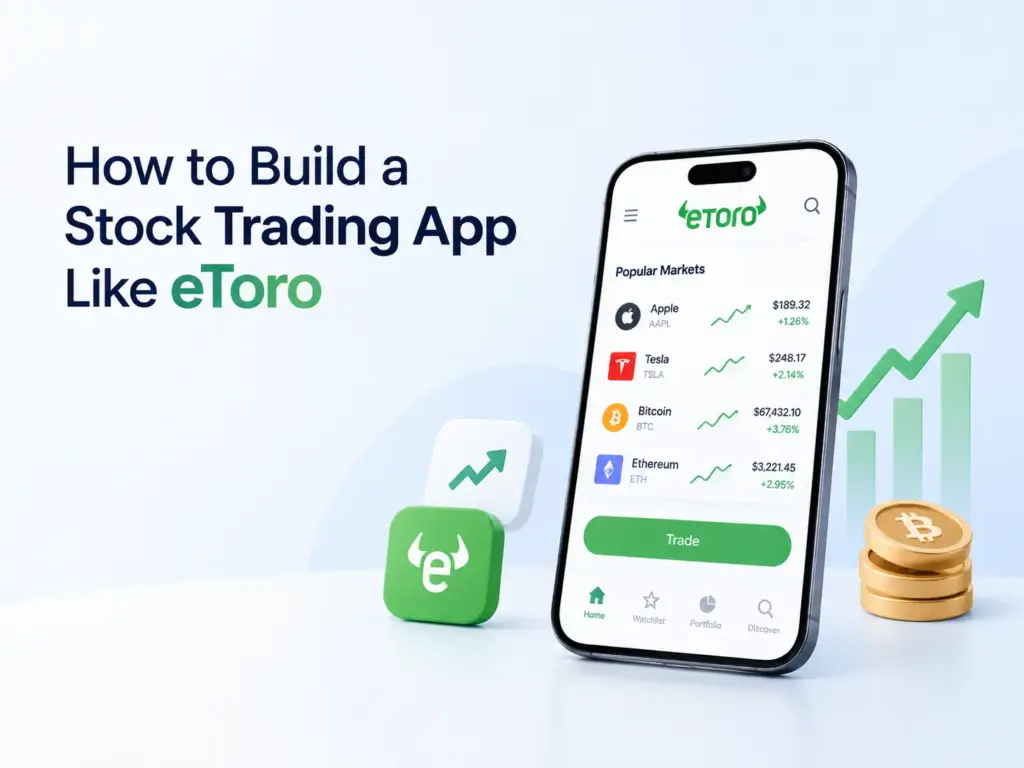
Retail investing has gone almost entirely mobile. People check their portfolio on the train, place trades on their lunch break, and follow other investors the same way they’d follow someone on social media. Apps like eToro built an entire business around that shift, combining trading with a social layer that made investing feel less intimidating for beginners.
The stock trading app market reflects that momentum. It was valued at roughly $76.6 billion in 2026 and is projected to reach $150.8 billion by 2030, growing at close to 18.5 percent a year according to Research and Markets. That kind of growth is why fintech founders keep asking the same question: what would it actually take to build something like eToro?
This guide breaks that down. The features that matter, the compliance groundwork you cannot skip, what it costs, and how the whole thing actually gets built.
What Makes an App Like eToro Different From a Basic Trading App
A basic trading app lets you buy and sell. A platform like eToro adds a social layer on top, letting less experienced investors follow or copy people who know what they are doing, while giving experienced traders a way to build a following and earn from it.
That combination, straightforward trading plus social discovery, is what turned eToro from a niche broker into a platform with millions of users. It is also what makes building one genuinely more complex than a standard brokerage app.
Core Features You’ll Need
Rather than listing every feature flat, it helps to think about what each group of users actually needs from the app.
Getting started and staying informed: Account registration with identity verification, real time price data, a searchable stock dashboard, watchlists, and price alerts. This is the baseline every trading app needs before anything else matters.
Placing and managing trades: Clear buy and sell order flows, interactive charts with basic indicators, a portfolio view showing holdings and performance, and full transaction history. Fractional share support is worth including too, since it lets people invest in expensive stocks without needing the full share price upfront.
The social and copy trading layer: This is what sets an eToro style app apart. Investor profiles with performance history and risk level, the ability to follow or copy a trader automatically, adjustable copy limits, and a feed where users can see what others are trading and discussing.
Money movement: Secure deposits and withdrawals, clear balance displays, and support for multiple currencies if you are targeting international users.
Behind the scenes: An admin panel for managing users, KYC approvals, transactions, and platform reports, plus role based access so sensitive controls stay limited to the right people.
Smart additions once the core is solid: AI generated portfolio summaries, risk pattern detection, and personalized market alerts. These add real value, but they work best once you already have trading data flowing through the platform, not as day one features.
Choosing Your Market Data and Brokerage Setup
Before any of the features above can work, you need a reliable source of live prices and a way to actually execute trades. Most companies building an app like this connect to an existing brokerage or market data provider through an API rather than becoming a licensed broker themselves, at least in the early stages.
This decision shapes almost everything else. Your provider determines which markets and assets you can offer, how fast price updates arrive, and how trades actually settle. It is worth treating this as a business decision as much as a technical one, since switching providers later is disruptive.
Compliance: What You Actually Need to Think About
This is the part that trips up a lot of first time fintech founders, so it deserves real attention rather than a quick mention.
Licensing. Depending on your country and business model, you may need a brokerage or investment license yourself, or you may be able to operate through a licensed partner broker. Confirm which path applies to you before building anything.
Identity verification. Know Your Customer checks are non negotiable. Users need to be verified before they can fund an account or place a trade, and the exact requirements vary by country.
Transaction monitoring. Once someone is verified, you still need systems that flag unusual activity, since anti money laundering rules require ongoing monitoring, not just a one time check at signup.
Data protection. A trading app handles some of the most sensitive personal and financial data there is. Wherever your users are based, follow the applicable privacy laws and be transparent about how their data gets used and stored.
Investor disclosures. People need to clearly understand fees, risks, and whether your platform executes trades only or also offers advice, since that distinction usually carries different regulatory obligations.
This is general information, not legal advice. Regulatory requirements differ significantly by country and by exactly what your platform does, so get advice from a lawyer or compliance consultant familiar with your specific target market before launch.
Tech Stack for a Stock Trading App
| Layer | Common choices |
|---|---|
| Mobile app | Flutter, React Native, Swift, Kotlin |
| Web app | React.js, Next.js |
| Backend | Node.js, Python, Java |
| Database | PostgreSQL, MongoDB |
| Real time data | WebSockets, Redis |
| Market and brokerage APIs | REST APIs, FIX protocol |
| Cloud infrastructure | AWS, Google Cloud, Azure |
| Security | OAuth 2.0, multi factor authentication, encryption |
| AI and analytics | Python, TensorFlow, LLM APIs |
The right mix depends on which markets you support and how much of the experience needs to update in real time versus refresh periodically.
How to Build a Stock Trading App, Step by Step
- Define your audience and business model first. Decide whether you are building for beginners, active traders, or both, and which assets you will support at launch. This shapes almost every decision that follows.
- Lock in your market data and brokerage partner. Get this sorted early since it determines your technical architecture and what features are even possible.
- Design around clarity, not complexity. Financial interfaces intimidate a lot of new investors. A clean onboarding flow, a simple portfolio view, and obvious buy and sell actions matter more than cramming in every possible tool from day one.
- Build the core trading functionality first. Registration, KYC, real time prices, order placement, and portfolio tracking need to work flawlessly before you add anything else.
- Layer in social and copy trading features. Once the core experience is solid, add trader profiles, copy trading controls, and the social feed that makes an eToro style app distinct.
- Build compliance and security in, not on. Encryption, KYC, AML monitoring, and audit logging need to be part of the architecture from the start, not bolted on right before launch.
- Test under real conditions, then launch and monitor closely. Check how the system behaves under high trading volume, verify every third party integration, and once live, keep a close eye on server performance and failed transactions as your user base grows.
What Does It Cost to Build a Stock Trading App Like eToro?
| Complexity | Estimated cost | What it typically includes |
|---|---|---|
| Basic MVP | $25,000 to $45,000 | Core trading, KYC, portfolio tracking, one asset class |
| Mid level platform | $45,000 to $90,000 | Multiple assets, watchlists, alerts, basic social features |
| Advanced, eToro style platform | $90,000 to $160,000+ | Full copy trading, social feed, AI insights, multi market support |
A few things that move these numbers the most:
- How many markets and asset classes you support at launch.
- Whether copy trading and social features are part of the first version or added later.
- The compliance and licensing complexity of your target market.
- How many third party integrations you need for data, payments, and identity verification.
- Whether you build AI features into the MVP or wait until you have real usage data.
If this is your first fintech product, starting with a focused MVP and adding the social layer once you have proven demand is almost always the safer path.
How These Apps Make Money
Most platforms combine a few of these revenue streams rather than relying on just one.
- Trading fees or commissions, even on platforms that market themselves as commission free for standard trades.
- The spread, the small difference between the buy and sell price on an asset.
- Premium subscriptions, offering advanced charts, research, or analytics for a monthly fee.
- Copy trading fees, either from users copying certain strategies or from the traders being copied.
- Currency conversion fees, relevant for any platform serving users across multiple countries.
- Interest on uninvested cash, where regulations allow it.
- Premium AI tools, like deeper portfolio analysis or personalized market insights as a paid add on.
Common Mistakes to Avoid
- Treating compliance as a launch day checklist item. It needs to shape your architecture from the very first planning conversation.
- Building the social layer before the trading core is solid. Copy trading only works if the underlying trade execution is fast and reliable.
- Overcomplicating the first version. A confusing app scares off exactly the beginner investors this category tends to attract.
- Picking a market data provider without stress testing it. Some providers handle high volume periods far better than others, and you will not know which until real trading activity hits.
- Skipping clear risk disclosures. Beyond the legal risk, unclear fee structures and risk warnings quietly erode user trust over time.
Final Thoughts
Building a platform like eToro is as much about trust and compliance as it is about features. Get the core trading experience fast and reliable, handle compliance properly from day one, and add the social and AI layers once you have real users to learn from.
Luminoguru has built more than 20 fintech platforms, including neobanking and wealth management products, and you can read more about that work in our fintech app development case study. Our AI development services team can also help layer in portfolio insights and risk detection once your platform is live. Get in touch if you’d like to talk through what this could look like for your project.
Frequently Asked Questions
How much does it cost to build a stock trading app like eToro?
A basic MVP typically runs $25,000 to $45,000. A mid level platform with more asset classes and light social features falls between $45,000 and $90,000, and a full eToro style platform with copy trading and AI features can run $90,000 to $160,000 or more.
How long does it take to build one?
A focused MVP usually takes 3 to 4 months. A mid level platform takes closer to 5 to 7 months, and a full featured platform with social and copy trading can take 8 to 12 months, largely depending on how much compliance work your target market requires.
Do I need to become a licensed broker to launch a trading app?
Not necessarily. Many platforms launch by partnering with an already licensed broker and connecting through their API, which is usually faster than pursuing your own license from day one. Whether that path works for you depends on your country and business model, so confirm it with a compliance advisor early.
Is copy trading legal everywhere?
It is permitted in most major markets, but the specific rules around disclosures, risk warnings, and how it can be marketed vary by country. This is one area worth getting specific legal guidance on before building the feature.
Should AI features be part of the first version?
Generally no. Get the core trading and portfolio experience right first. AI features like portfolio insights and risk detection work better once you have real trading data to learn from, and adding them later is far less risky than trying to launch everything at once.
What’s the biggest technical challenge in building an app like this?
Keeping prices and order execution accurate and instant, even when trading volume spikes. This usually comes down to how well your backend handles real time data and how reliable your market data provider is under pressure.