 Mobile App Development
 Artificial Intelligence
 Software Development
 Generative AI
 QA & Testing
 UI/ UX Design
 IoT App Development
 Cloud App Development
 MVP Development
 SEO Services
 AI Code Optimization
 AI Integration Services
 Food Delivery
 Taxi Booking
 E-Commerce
 Mobile Game
 Logistics
 Real Estate
 Healthcare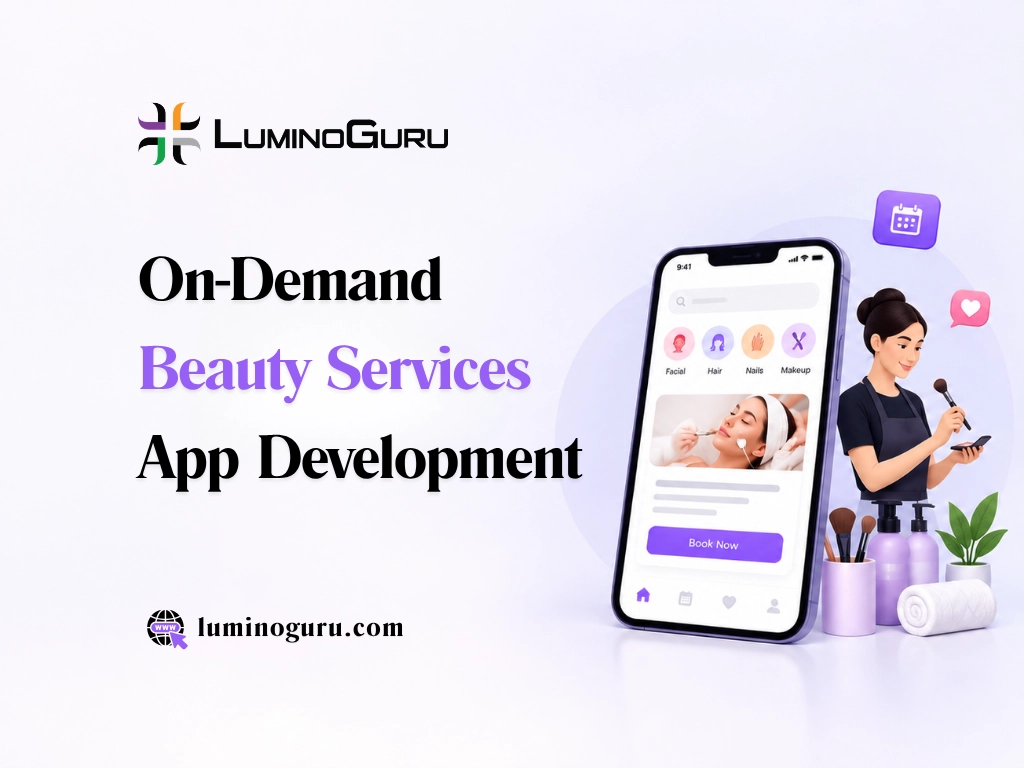
On-demand beauty services app development means building a mobile and web platform that connects customers with beauty professionals, at home or in a salon, with live availability, booking, payments and payouts. The hard parts are travel-aware scheduling, verifying professionals, and a revenue model that keeps repeat bookings on the platform. A focused first version costs roughly $25,000 to $60,000.
This guide covers the platform models that exist today, the features that matter, how scheduling and matching should work, what the leading apps charge, and what the build costs. It also covers where these projects go wrong, since most failures are about supply and operations, not code.
How does an on-demand beauty services app work?
A customer picks a service, a time and a place. The app finds professionals who can do that service, are free at that time, and can reach the location. The customer pays, the professional accepts and delivers the service, and the payout follows after completion.
Four groups use the platform. Customers book and pay. Professionals manage their calendar, accept jobs and track earnings. Salon or spa partners manage several staff and branches, if your model includes them. Your admin team handles verification, support, refunds and payouts.
Which type of beauty platform should you build?
| Model | Who sets price and quality | Hardest build problem | Example |
|---|---|---|---|
| Managed at-home platform | The platform | Training, assignment, safety and support cost | Urban Company (India) |
| Open marketplace of independent professionals | Professionals, within your rules | Verification, and keeping repeat bookings on the platform | Marketplaces for solo stylists and makeup artists |
| Salon and spa booking marketplace | Each salon | Syncing with salon calendars and payments | Fresha |
| Single-brand app | The brand | Consistent records, pricing and memberships across branches | A salon chain’s own app |
These models overlap. A salon chain can add home visits, and a marketplace can specialise in bridal work. Pick one starting model and one service area before you add anything else.
How big is the market for beauty booking apps?
Salon and spa software alone is worth more than $1 billion and growing about 10% a year. Mordor Intelligence puts the spa and salon software market at $1.12 billion in 2026, reaching $1.86 billion by 2031, a CAGR of 10.68%.
The same report found that small and individual professionals held 52.89% of the market in 2025. That tells you where supply sits: mostly solo professionals and small shops, not big chains. Onboarding thousands of small operators is the real work of a beauty marketplace.
Two operators show how different the models are. Urban Company runs a managed marketplace in India, where the platform controls pricing and service standards, according to a February 2026 JM Financial research note. Fresha gives salons free scheduling software and earns from payments and a fee on new marketplace clients, per HeyBooked’s August 2026 pricing review.
Should you build a managed platform or an open marketplace?
Start with an open marketplace in one city, unless you can fund training, quality control and support. A managed model gives you control, but it also makes every failure your cost.
When the platform sets prices and standards, it also owns the refunds, no-shows and reassignments. The JM Financial note lists Urban Company’s standard fee at 28.3% of service value, with a slightly lower rate for professionals who complete more than 30 services a month. A take rate that high only works when you also run onboarding, quality checks and support.
An open marketplace is lighter. Professionals set their own services and availability within your rules, and you provide discovery, booking and payments. You carry less operational weight, but you have less control over quality, so verification and reviews matter more.
What features does an on-demand beauty app need?
The features that matter most are the ones that stop bad bookings: travel-aware availability, slot holds at checkout, clear cancellation rules and verified professionals. Everything else can follow.
For customers, build search by service, area and time, profiles with portfolios grouped by service, upfront pricing including travel fees, secure payment with optional deposits, live status updates, and simple rebooking with the same professional. Collect allergy and patch-test information before hair colour or chemical treatments.
For professionals, build onboarding with identity and licence checks, a calendar with working hours, breaks and buffers, a job screen that shows location, services, duration and earnings before acceptance, and a clear earnings and payout view. Licensing rules for beauty professionals vary by country and, in the US, by state, so confirm what applies to home visits in your market.
For salon partners, build multi-branch menus and prices, staff and room allocation, and a calendar that merges app bookings with phone and walk-in bookings. Decide early which system is the source of truth when the two disagree.
For admins, build verification review, live booking monitoring, refunds and dispute tools, payout reconciliation, and role-based access with audit logs. For at-home services, add arrival check-ins, a start code shared by the customer, and an incident button that reaches a staffed support team.
How should scheduling and matching work?
Filter first, then rank. Remove every professional who can’t do the service, can’t reach the address in time, or isn’t free. Only then rank the rest by rating, price, distance and past bookings.
Here is a worked example. A customer wants a 60-minute facial at 3:00 pm. A professional’s previous job ends at 2:00 pm, the drive takes 25 minutes, and setup takes 10. The earliest realistic start is 2:35 pm, so 3:00 pm works. If the previous job ended at 2:30 pm, the same slot would show as available on a plain calendar but fail in real life.
To get this right, calculate travel time with a routing service such as Google Maps Platform’s Routes API or Mapbox’s Matrix API. Recheck availability at checkout, and hold the slot for a short window, often about ten minutes, while the customer pays. Keep pending requests separate from confirmed bookings, and set an acceptance deadline so unanswered requests move to the next professional.
If no one is available, offer another time or a waitlist instead of a dead end. Log every search that returns nothing, because that data tells you where to recruit next.
AI can help once you have real bookings. Ranking and cancellation prediction need history, so start with rules and add models later. Our AI development services team can scope this once your core booking flow is stable.
How do beauty apps make money?
Most combine a booking commission, a payment fee and optional subscriptions. The key choice is whether you charge on every booking or only on new customers, because that decides how much you lose when people book directly.
| Model | How it works | Trade-off |
|---|---|---|
| Commission on every booking | A percentage of each service, as in a managed platform | Highest revenue, strongest urge for customers and professionals to go off-platform |
| New-client fee only | Fresha charges 20% on a new marketplace client’s first visit, with a $6 minimum, and nothing on later visits | Fair to professionals, but you earn little on loyal repeat customers |
| Payment processing margin | A small fee on each card payment | Steady, scales with volume, needs good payout handling |
| Professional subscription | Monthly fee for scheduling, reminders and client tools | Predictable, but needs tools worth paying for |
| Customer booking fee or membership | Disclosed fee, or a recurring plan with perks | Easy to over-discount, so model redemption carefully |
Model professional earnings and your margin together. If your fee makes a reliable professional’s income too thin, they will leave, and your supply goes with them.
What tech stack should you use?
Use a cross-platform mobile framework, a transactional database and a payments provider built for marketplaces. Cost and speed matter more than novelty at this stage.
| Layer | Common choices |
|---|---|
| Mobile apps | Flutter or React Native for customers and professionals |
| Admin dashboard | React with role-based access |
| Backend | Node.js, Python or Java |
| Database | PostgreSQL with a geospatial extension such as PostGIS |
| Payments and payouts | Stripe Connect, or Razorpay Route in India |
| Maps and travel time | Google Maps Platform or Mapbox |
| Messaging | Push notifications, SMS and in-app chat |
How much does on-demand beauty services app development cost?
Expect about $25,000 to $60,000 for a focused first version, $60,000 to $120,000 for a growth platform, and $120,000 to $250,000 or more for a multi-city build. These are planning estimates, not quotes.
| Scope | What it includes | Estimated cost | Timeline |
|---|---|---|---|
| Focused MVP | One city, customer and professional apps, basic admin, standard payments | $25,000 to $60,000 | 4 to 6 months |
| Growth platform | Salon partner panel, memberships, calendar sync, reporting, payouts | $60,000 to $120,000 | 6 to 9 months |
| Multi-city platform | Localisation, complex settlements, enterprise integrations, advanced matching | $120,000 to $250,000+ | 9 to 14 months |
Cost rises with travel-aware scheduling, calendar integrations with salon systems, multi-professional bookings and payments across countries. If you want to test demand before committing to a larger build, our MVP development services can scope a narrow first release.
Budget for running costs too: maps and messaging fees, payment processing, verification checks, support staff and professional recruitment. Judge your economics per completed appointment, not per month, because a growing booking count can expose a weak margin that low infrastructure spend hides.
How do you build an on-demand beauty app, step by step?
- Pick one city and one service type, then count the qualified professionals who could realistically join. If you can’t find enough, change the plan before you build.
- Write the operating rules: who sets prices, who accepts bookings, how cancellations and refunds work, and who pays when a professional doesn’t show.
- Scope the MVP around the full booking lifecycle, including failure paths such as a missed arrival or a declined payment.
- Design all panels, not just the customer app, and test the professional screens with real stylists on a phone between jobs.
- Build with security from the start: role-based access, encrypted personal data, audit logs and minimal collection of addresses and photos.
- Integrate payments, maps and messaging, and test double bookings, refunds and payout failures before launch. A team offering mobile app development services can build the customer and professional apps together so they share one booking record.
- Launch a pilot in one neighbourhood, track failed assignments and cancellations, and expand only when fulfilment and repeat bookings hold up.
What mistakes sink beauty apps?
The most common is launching with too few professionals. Customers who search and find nothing don’t come back, so recruit before you promote.
Calendars that ignore travel time come next. They create bookings that look fine and fail on the day. Close behind is a fee model that pushes people off-platform, which turns acquisition spend into one-off bookings.
Weak safety and support is the costly one for at-home services. Identity checks, check-ins and a staffed incident route need to exist before the first home visit, not after the first complaint.
Managed platforms also carry exposure on how they treat professionals, including assignment, account blocking and training costs. Clear written rules and an appeal route protect both sides.
Finally, many teams add AI before they have data. Start with rules, measure acceptance and cancellation rates, and add models when they beat the rules.
When should you not build a beauty app?
On-demand beauty services app development is the wrong move when you can’t recruit enough professionals in one area, when you can’t fund support and safety for home visits, or when “Fresha but cheaper” is your only pitch.
If you already run a salon, a booking widget on your site or an existing tool may serve you better than a custom app. Build custom when you have a specific niche, a supply of professionals, and a reason customers would leave their current app. If you need help judging that, our custom software development team can walk through the options.
How Luminoguru can help build your beauty services platform
Luminoguru is a global software and digital company with a team of more than 100 engineers, designers and project managers, building digital products since 2014. For on-demand beauty services app development, we cover product discovery, mobile and web engineering, cloud architecture, payment and maps integrations, and AI features once your booking data can support them.
The first conversation should settle how your services operate: who supplies them, who controls availability, and what happens when a booking fails. Those answers decide your platform model, your fee structure and your launch city, so we start there before we talk about screens.
From there, we define the customer, professional, salon partner and admin workflows inside one delivery scope. That includes matching and travel-time rules, appointment states, payout and refund logic, access controls and reporting.
We usually recommend a focused first release in one area, with a pilot that tests demand, professional participation and appointment economics before you expand. We deliver from India, with a US office in California, and we agree an overlap window with your team so you can work with us in real time.
Book a consultation and bring your service model, launch city and questions with you.
Frequently asked questions
How much does it cost to build a beauty services app?
A focused MVP typically costs $25,000 to $60,000. A growth platform with salon partners and calendar sync runs $60,000 to $120,000, and a multi-city platform can reach $250,000 or more. Integrations, travel-aware scheduling and payments across countries move the price most.
How long does it take to build an on-demand beauty app?
A focused MVP usually takes 4 to 6 months. A growth platform takes 6 to 9 months, and a multi-city build with advanced matching can take 9 to 14 months. Recruiting professionals should start in parallel, not after launch.
Can I build an app like Urban Company?
Yes, but the software is the smaller part. Urban Company runs a managed marketplace, so you would also need training, quality checks, support and safety systems. Most new entrants start smaller, with an open marketplace in one city.
Should I start with at-home services or salon booking?
Salon booking is simpler, since the professional and equipment are already in one place. At-home services add travel time, safety and equipment logistics. Start with salons unless home visits are the core of your idea and you can fund the extra operations.
How do you stop customers from booking professionals off the platform?
Make staying more useful than leaving. Offer payments with deposits, rebooking, reviews, reminders and support inside the app, and consider charging a fee only on new customers, as Fresha does, so loyal repeat bookings don’t feel penalised.
Are beauty professionals employees or contractors on these platforms?
It varies by country and by how much control the platform exerts. Managed models face more scrutiny than open marketplaces. Get local legal advice on worker classification, licensing and insurance before you finalise your operating model.
Key takeaways
On-demand beauty services app development works best when you pick one city and one model, and prove you can recruit professionals before you build for scale. Treat travel-aware scheduling, safe onboarding and a fair fee model as core features, not extras. Judge your economics per completed appointment, and add AI only once you have booking data.
If you’re weighing a beauty or on-demand service platform and want an honest view on scope and cost, get in touch.