 Mobile App Development
 Artificial Intelligence
 Software Development
 Generative AI
 QA & Testing
 UI/ UX Design
 IoT App Development
 Cloud App Development
 MVP Development
 SEO Services
 AI Code Optimization
 AI Integration Services
 Food Delivery
 Taxi Booking
 E-Commerce
 Mobile Game
 Logistics
 Real Estate
 Healthcare
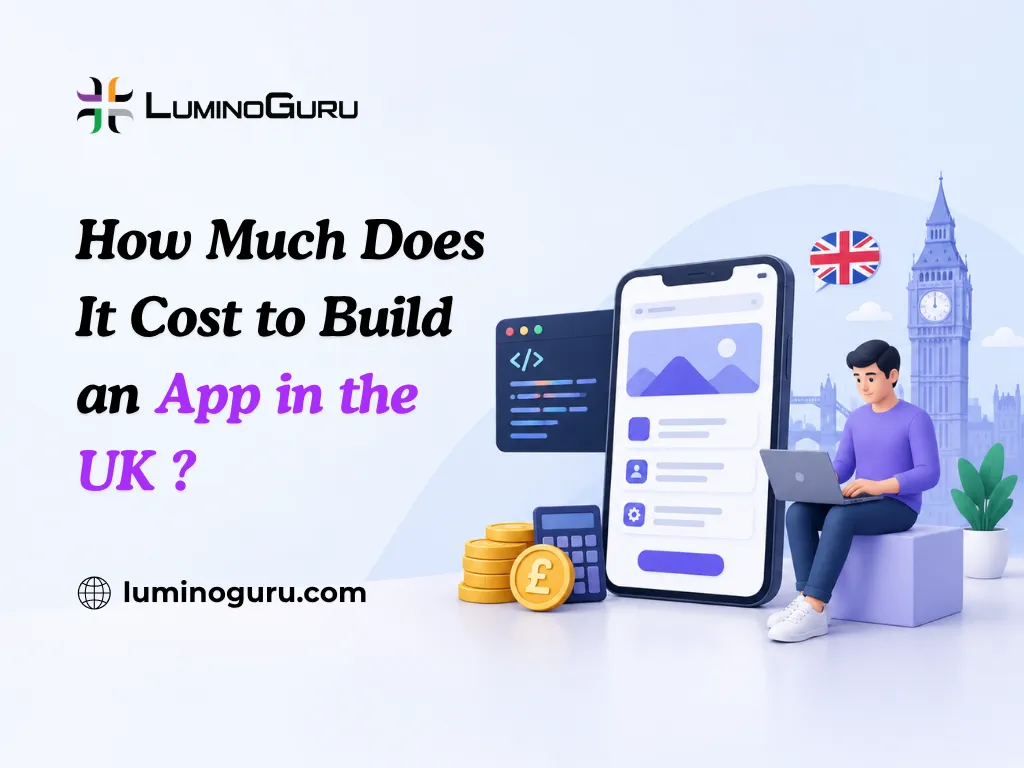
Building a mobile app in the UK can cost anywhere from around £20,000 to over £200,000, depending on its features, design, technology and backend requirements. A simple MVP needs a smaller investment than a multi-user platform with payments, real-time updates and complex integrations. The best way to estimate your budget is to calculate the work your app actually needs.
If you’re a startup founder or business owner, knowing the development cost before hiring a team helps you avoid unnecessary features, plan your launch and prepare for expenses after release.
Let’s look at how app development budgets work, what different features can cost and how you can make better decisions about your investment.
How much does mobile app development cost in the UK in 2026?
A UK mobile app project can range from approximately £20,000 for a focused MVP to £200,000 or more for a complex business application. These are indicative planning ranges, not fixed market prices. The final quote depends on development hours, team rates, technical requirements and project scope.
Here is a practical starting point for budgeting.
| App type | Indicative development budget | Typical scope |
|---|---|---|
| Basic app | £20,000 to £35,000 | Basic screens, user accounts, content and simple navigation |
| MVP app | £25,000 to £60,000 | Core product features, backend and essential integrations |
| Medium-complexity app | £60,000 to £110,000 | Custom workflows, payments, dashboards and APIs |
| Complex app | £110,000 to £200,000 | Multiple user roles, real-time features and advanced integrations |
| Enterprise app | £200,000+ | Complex architecture, advanced security and business system integrations |
These ranges are working estimates for early planning. They assume a professional development process that includes planning, design, engineering and testing. They do not automatically include VAT, major marketing campaigns, extensive legal work or long-term operational expenses.
A useful distinction: an app with ten screens is not necessarily cheaper than one with twenty screens. A single payment workflow or real-time tracking feature can require more engineering than several simple information screens.
What does a typical app budget include?
A development quote should explain how the budget is divided across the project.
For example, consider an illustrative £60,000 app project:
| Development activity | Example allocation |
|---|---|
| Discovery and technical planning | £5,000 |
| UI/UX design and prototyping | £8,000 |
| Frontend and backend development | £32,000 |
| Testing and quality assurance | £7,000 |
| Deployment and launch preparation | £3,000 |
| Project management and delivery | £5,000 |
| Total | £60,000 |
This is an example budget allocation, not a supplier price list. Some agencies include project management within their engineering costs, while others list it separately.
When comparing quotations, check that both providers are pricing the same deliverables.
Which factors affect mobile app development cost in the UK?
The development cost mainly depends on the amount of work required to make the app function reliably. The following factors usually have the greatest effect on your budget.
How does app complexity change the development price?
Complexity affects cost because each additional workflow requires design, coding, testing and sometimes backend changes.
Consider three examples:
-
A booking app needs service listings, availability, booking confirmation and user accounts.
-
A marketplace needs buyer and seller accounts, product listings, search, payments and order management.
-
A delivery app may need customer and driver applications, location tracking, order assignment and real-time status updates.
The third example requires more coordination between users, devices and backend services. That increases development effort.
Before requesting a quote, list the main actions each type of user must complete. This gives developers a clearer picture of the actual workload.
How do app features affect the total cost?
Features have different development requirements. Basic screens are usually less expensive than features that connect multiple systems or process live information.
Here is an illustrative feature-level effort guide.
| Feature | Development effort | Why it affects cost |
|---|---|---|
| Email and social login | Low to medium | Authentication and account management |
| User profiles | Low to medium | Profile forms, editing and data storage |
| Push notifications | Medium | Notification services and event triggers |
| Payment integration | Medium to high | Payment provider setup, transaction handling and testing |
| Search and filters | Medium | Search logic, indexing and filtering |
| Live chat | High | Real-time messaging and notification handling |
| GPS tracking | High | Location permissions, maps and live location updates |
| Admin dashboard | Medium to high | Management screens, permissions and reporting |
| AI-based recommendations | High | Data processing, model integration and evaluation |
These are relative effort categories, not individual price quotations. The actual cost depends on the feature’s scope.
For example, adding a payment button is different from building a complete payment system with refunds, transaction history, subscriptions and administrator controls.
Does UI/UX design affect app development cost?
Yes. Custom design, user research, interactive prototypes and usability testing increase the initial design budget.
However, reducing design work too much can create problems during development. Developers may have to make assumptions about navigation, form behaviour and user permissions. Fixing these decisions after coding has started can increase the total project cost.
A proper design phase should include:
-
User journeys and navigation structure.
-
Wireframes for important screens.
-
Interactive prototypes.
-
Responsive layouts for different screen sizes.
-
Accessibility considerations.
-
Design handoff specifications.
If you need help planning the experience before development begins, explore our UI/UX design services.
Does choosing iOS, Android or both change the price?
Yes. Building separate native applications for iOS and Android generally requires more development work than targeting one platform.
You have three main choices:
| Approach | Technology | Cost consideration |
|---|---|---|
| Native iOS | Swift | Dedicated iOS development |
| Native Android | Kotlin | Dedicated Android development |
| Cross-platform | Flutter or React Native | Shared codebase for multiple platforms |
Cross-platform development can reduce duplicated engineering work. Flutter, for example, supports building applications for multiple platforms from a shared codebase. However, platform-specific features may still require additional implementation.
Flutter Documentation
Choose native development when your application depends heavily on platform-specific capabilities, specialised device features or highly customised performance requirements.
Choose cross-platform development when your business needs similar functionality on both platforms and a shared codebase fits the technical requirements.
It is not always cheaper to choose one technology simply because its initial development estimate is lower. Consider future updates, performance and the availability of developers too.
How do backend and third-party integrations affect cost?
The backend is the part of your application that manages information, business rules and communication between systems.
A simple app may need basic user authentication and a database. A larger platform may require:
-
Multiple user roles and permissions.
-
Payment gateway integration.
-
CRM or ERP connectivity.
-
Product and inventory management.
-
Real-time data synchronisation.
-
Analytics and reporting.
-
Automated emails and notifications.
Every integration introduces additional work. Developers need to understand how the external service works, connect it securely, handle errors and test different scenarios.
For example, an e-commerce app connected to an existing inventory system needs more backend work than an app that displays a static product catalogue.
How do security and UK compliance requirements affect the budget?
Applications that collect personal information need suitable privacy and security controls. The work depends on the type of data, how it is used and the risks involved.
For UK businesses, relevant considerations include UK GDPR and the Data Protection Act 2018.
Your development plan may need:
-
Secure authentication and access permissions.
-
Encryption for sensitive information.
-
Clear consent and privacy controls.
-
Data retention and deletion processes.
-
Secure API communication.
-
Activity logs and monitoring.
-
A documented approach to security incidents.
The ICO explains that organisations must report certain personal data breaches without undue delay and, where feasible, within 72 hours of becoming aware of them. This makes incident detection and response planning a practical part of application operations.
ICO+1
Do not treat compliance as a feature that can simply be added at the end. Your data handling decisions can affect the application architecture from the beginning.
How much does it cost to develop different types of mobile apps?
The app category gives you a starting point, but its actual functionality determines the final cost. Two apps in the same category can have very different budgets.
Here are some examples to help you understand the differences.
How much does an e-commerce app cost?
An e-commerce application may cost approximately £30,000 to £100,000 or more, depending on its features and integrations.
A basic shopping app may include:
-
Product catalogue.
-
Product details and search.
-
Customer accounts.
-
Shopping cart.
-
Payment integration.
-
Order history.
A more advanced application may need inventory synchronisation, discount management, delivery tracking, multiple sellers and personalised recommendations.
If you already have an online store, connecting the app to your existing platform may reduce duplicated work. However, the quality of its APIs and existing data structure will affect the estimate.
How much does a food delivery app cost?
A food delivery application can cost approximately £50,000 to £150,000 or more.
The reason is that the product often involves multiple connected interfaces:
-
A customer application for browsing and ordering.
-
A restaurant or merchant dashboard for managing orders.
-
A delivery partner interface for accepting and completing deliveries.
-
An administration panel for managing the overall platform.
Live order updates, GPS tracking, payment handling and delivery assignment add further engineering work.
A startup can reduce its first release scope by launching in one service area and managing some operations manually before automating every workflow.
How much does a marketplace app cost?
A marketplace app may cost approximately £60,000 to £180,000 or more.
Unlike a basic shopping application, a marketplace connects different user groups. Buyers, sellers and administrators may all need different permissions and features.
The development scope can include:
-
Seller registration and verification.
-
Product or service listings.
-
Search and filtering.
-
Buyer and seller messaging.
-
Payment and commission handling.
-
Reviews and ratings.
-
Dispute management.
-
Administrative controls.
The payment model deserves special attention. A platform that collects payments and distributes funds to sellers has different technical and operational requirements from one that simply redirects customers to external payment providers.
How much does a healthcare app cost?
A healthcare app may cost approximately £50,000 to £200,000 or more, depending on its intended use.
A simple appointment booking app has a different technical scope from a product that manages patient records, medical information, remote consultations and integrations with healthcare systems.
The budget may increase due to:
-
Sensitive data protection.
-
Role-based access.
-
Secure communication.
-
Audit trails.
-
Healthcare system integrations.
-
Clinical validation or specialist regulatory requirements.
Do not use a generic consumer app architecture for a healthcare product without assessing its data protection and regulatory needs.
These category ranges are planning estimates, not verified industry averages. A proper estimate needs a feature list and technical assessment.
Should you build an MVP or a complete mobile application?
An MVP is usually the better starting point when you have an untested product idea or limited evidence of customer demand. A full-scale application makes more sense when the core business model and required functionality are already understood.
| Factor | MVP | Full application |
|---|---|---|
| Initial investment | Lower | Higher |
| Features | Essential workflows | Complete planned functionality |
| Development scope | Limited | Broad |
| Testing | Core user journeys | Wider feature and integration coverage |
| Best suited for | Early-stage startups | Established products and businesses |
| Future development | Expanded after feedback | More functionality available at launch |
For example, imagine you’re planning a marketplace for used vehicles.
Your first version might include seller registration, vehicle listings, search, buyer enquiries and an admin panel.
You may not need advanced recommendations, automated dealer analytics, live auctions and complex integrations in the first release.
Once you understand how users interact with the product, you can decide which additional features deserve investment.
An MVP should not mean poor security, unreliable code or an unfinished user experience. It means building a smaller product with a clear purpose.
How long does it take to build a mobile app in the UK?
A mobile application can take several weeks to more than a year to develop. The timeline depends on the number of features, platform requirements, integrations and how quickly decisions are made.
These are indicative planning estimates:
| Project type | Estimated timeline |
|---|---|
| Simple application | 2 to 3 months |
| Focused MVP | 3 to 5 months |
| Medium-complexity app | 4 to 7 months |
| Complex application | 7 to 10 months |
| Enterprise platform | 9 to 12+ months |
The stages usually include:
-
Discovery and planning: Define the audience, product requirements and technical scope.
-
UI/UX design: Create user journeys, wireframes and interactive prototypes.
-
Development: Build the frontend, backend, database and integrations.
-
Quality assurance: Test functionality, security, compatibility and performance.
-
Deployment: Prepare the application for store submission and release.
-
Post-launch support: Monitor issues and plan updates.
Some activities can run in parallel. For example, backend development can begin while the design team completes approved application screens.
However, rushing the discovery or testing stages can create expensive changes later.
Should you hire a UK app development company or an offshore team?
Both options can work. Your choice should depend on the project requirements, communication needs, available budget and technical expertise.
A UK-based development company may offer easier communication during local working hours and a stronger understanding of the UK business environment.
An offshore team may offer a lower hourly rate and access to a wider talent pool. However, you need clear project management, quality checks and ownership agreements.
Before comparing prices, check:
-
Who will manage the project?
-
Who is responsible for quality assurance?
-
Will you have direct access to developers?
-
How will progress and delays be reported?
-
Who owns the source code and design files?
-
Are third-party licences and accounts registered in your company’s name?
-
What happens if you change development partners?
A lower quotation is not automatically better value. If important activities are excluded, the initial savings may disappear through additional invoices and rework.
Ask every supplier to provide the same feature scope, delivery milestones and assumptions before comparing quotations.
What are the hidden costs of maintaining a mobile app?
The initial development budget is only one part of the total cost. Once your application is live, you need money for hosting, maintenance, monitoring, third-party services and customer support.
Here are common expenses to include in your operating budget.
| Expense | What you need to budget for |
|---|---|
| App maintenance | Bug fixes, compatibility updates and improvements |
| Cloud hosting | Servers, databases, storage and bandwidth |
| Third-party APIs | Maps, messaging, payment and external services |
| Security | Monitoring, testing and security updates |
| Analytics | Usage tracking and performance reports |
| Customer support | Handling user queries and complaints |
| Marketing | App promotion and user acquisition |
What are the app store publishing fees?
Apple and Google charge separate registration fees for their developer programmes.
Apple lists its Developer Program membership at US$99 per year, with local currency pricing available where supported.
Apple Developer
Google Play Console charges a US$25 one-time registration fee.
Play Console Help
These are publishing account fees, not application development costs. They can change, so check the official requirements before launch.
How much should you reserve for annual maintenance?
For initial planning, you can use 15% to 20% of the original development budget as an illustrative annual maintenance allowance.
For a £60,000 application, that means planning approximately £9,000 to £12,000 per year.
This is a budgeting guideline, not a fixed industry charge. The actual amount depends on how often you release updates, your infrastructure, the number of integrations and the level of support required.
An application with stable functionality and limited usage may need less ongoing work than a marketplace with daily transactions and real-time operations.
How can you reduce mobile app development costs without affecting quality?
You can control the budget by reducing unnecessary development work, making technical decisions early and releasing features in stages. Cutting testing or security is not a good way to save money.
Here are practical ways to manage your spending.
1. Define the essential features first
Separate your requirements into three groups:
-
Must have: Features needed for the application to work.
-
Should have: Features that improve the experience but are not essential for launch.
-
Could have: Features that can wait until you have user feedback.
This helps developers estimate the first release without including every future idea.
2. Choose the right technology
Do not select a framework simply because it is popular. Consider your platform requirements, development team, expected performance and long-term maintenance.
Cross-platform development can reduce duplicated work when iOS and Android share similar functionality.
3. Use existing services where practical
You do not need to build every technical component from scratch.
Depending on your requirements, existing services can handle authentication, payment processing, notifications, analytics and cloud infrastructure.
However, check the pricing model, data handling rules and technical limitations before integrating a third-party service.
4. Prepare designs before development
Approved wireframes and prototypes help developers understand the required screens and user interactions.
This reduces misunderstandings and limits design changes during coding.
5. Release features in phases
Launch the most valuable workflows first. Review usage data and customer feedback before investing in additional functionality.
This approach helps you spend money on features that solve actual user problems instead of assumptions.
6. Plan the backend for realistic growth
Do not build expensive enterprise infrastructure before you need it. At the same time, avoid architecture that makes every future change difficult.
Choose a technical approach that supports your expected usage and can be expanded when business requirements grow.
How should you choose a mobile app development company in the UK?
Choose a development partner based on its technical ability, communication process, project transparency and willingness to explain trade-offs. A polished portfolio alone does not prove that a company can deliver your particular application.
Use this checklist before signing a contract:
-
Review applications that have similar workflows to yours.
-
Ask how the team handles discovery and technical planning.
-
Check whether design, development and testing are included.
-
Request a feature-based quotation.
-
Confirm the delivery milestones and payment schedule.
-
Ask how change requests are priced.
-
Confirm source code and intellectual property ownership.
-
Understand post-launch support and maintenance terms.
-
Check how project risks and delays are communicated.
You should also ask for a technical explanation of the proposed architecture. A reliable partner should be able to explain why a particular framework, database or cloud service fits your project.
At Luminoguru, our mobile app development services cover iOS, Android and cross-platform development using technologies including React Native and Flutter.
The right development approach should be based on what your business needs, rather than choosing technology first and trying to fit the product around it.
How can you calculate your mobile app development budget?
A feature-based calculation gives you a more useful starting estimate than choosing a random budget based on the app category.
Use this basic formula:
Estimated development cost = Total development hours × Blended hourly rate + Additional project expenses
For example, suppose you are planning an MVP with the following estimated effort:
| Activity | Estimated hours |
|---|---|
| Discovery and planning | 60 |
| UI/UX design | 100 |
| Frontend development | 220 |
| Backend development | 180 |
| Testing and QA | 100 |
| Deployment and project coordination | 60 |
| Total | 720 hours |
Assume a blended development rate of £85 per hour for this example.
720 × £85 = £61,200.
You would then account separately for any excluded costs, such as third-party subscriptions, cloud infrastructure, legal review and ongoing maintenance.
The £85 rate is an illustrative assumption, not a quoted Luminoguru rate or a universal UK market rate.
The estimate will become more accurate when developers review the actual user journeys, technical integrations, platform requirements and testing scope.
Frequently asked questions about mobile app development cost in the UK
1. Is £10,000 enough to build a mobile app in the UK?
£10,000 may be enough for a small prototype, a limited proof of concept or a narrowly scoped application. However, it may not cover a complete production-ready app with custom design, backend development, integrations and proper testing. Define your minimum requirements before committing the budget.
2. Is Flutter cheaper than native app development?
Flutter can reduce duplicated development work because teams can share much of the code between platforms. However, the final cost depends on the application requirements, platform-specific functionality and developer experience. It is not automatically cheaper for every project.
3. Can I build an app without hiring a development company?
Yes. No-code and low-code platforms can help you create prototypes and simple applications without a traditional engineering team. However, custom business workflows, advanced integrations, performance requirements and complex security needs may require experienced developers.
4. How much does it cost to update a mobile application?
The cost depends on the size of the update. Small bug fixes and compatibility changes may require limited development time, while new features, major redesigns or backend changes can become separate development projects. A maintenance agreement can help you plan recurring support expenses.
5. Is an MVP enough to attract investors?
An MVP can help demonstrate that your product works and give investors something concrete to evaluate. However, an app alone does not guarantee funding. Investors may also assess market demand, customer traction, revenue potential, team capability and the business model.
6. What should a mobile app development quotation include?
A useful quotation should explain the project scope, features, platforms, design deliverables, backend requirements, integrations, testing, timeline and payment milestones. It should also clarify source code ownership, third-party expenses, exclusions, change requests and post-launch support.
Key takeaways for planning your app budget
Mobile app development costs in the UK depend on what you are building, who is building it and how much functionality your business needs at launch.
Before committing to a development budget:
-
Start with a clear list of essential features.
-
Decide whether native or cross-platform development fits your product.
-
Include design, backend development and quality assurance in the estimate.
-
Set aside money for hosting, maintenance and external services.
-
Choose a development partner that provides clear pricing and ownership terms.
You do not need to build every planned feature in the first release. A well-scoped application gives you room to test your idea, learn from users and invest in improvements when they make business sense.
If you’re planning a mobile application and need help assessing its scope, technology or development budget, contact Luminoguru to discuss your requirements.