 Mobile App Development
 Artificial Intelligence
 Software Development
 Generative AI
 QA & Testing
 UI/ UX Design
 IoT App Development
 Cloud App Development
 MVP Development
 SEO Services
 AI Code Optimization
 AI Integration Services
 Food Delivery
 Taxi Booking
 E-Commerce
 Mobile Game
 Logistics
 Real Estate
 Healthcare
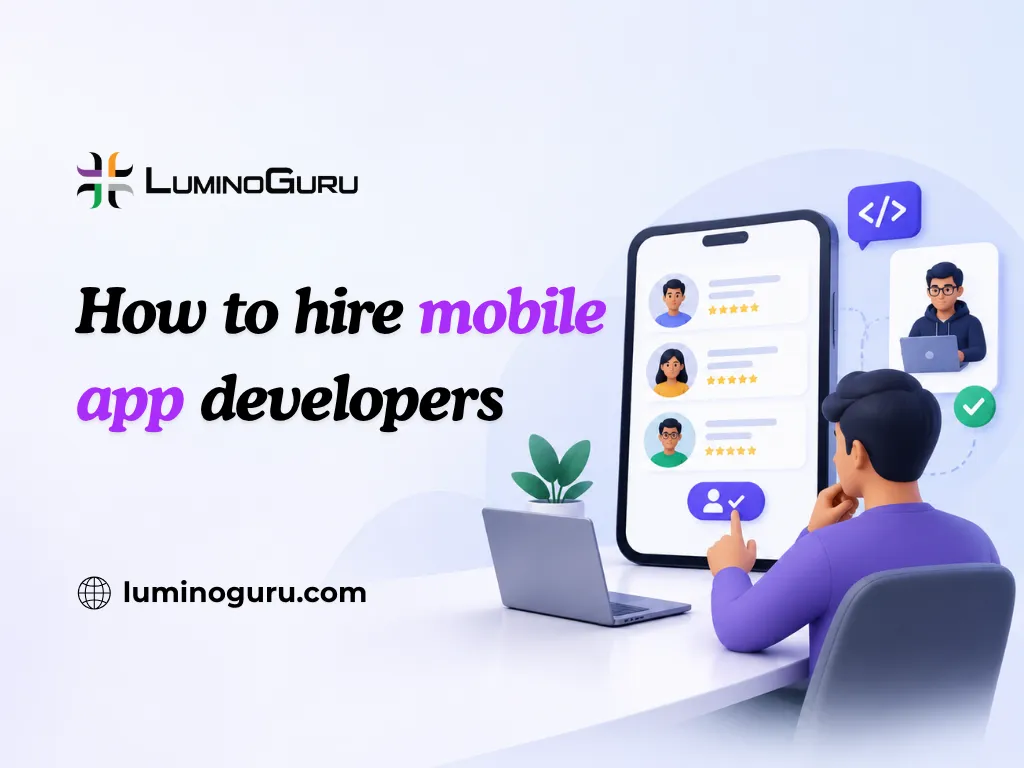
To hire mobile app developers well, write a one-page brief, pick the right hiring model (agency, freelancer or in-house), shortlist three to five teams, check live apps and references, run a small paid trial, and sign a contract that gives you the source code. Most budget losses come from skipping these steps.
Which hiring model is right for you: agency, freelancer or in-house?
It depends on your budget, timeline and whether app development is your core business. An agency suits most first-time founders, a freelancer suits small fixes, and an in-house team suits companies that will build apps for years.
| Model | Best for | Main risk | Typical monthly cost pattern |
|---|---|---|---|
| Agency | New products with a clear deadline | Higher rate, vendor lock-in if code is not handed over | Project fee or monthly team fee |
| Dedicated team from a vendor | Long builds that change often | You must manage priorities daily | Fixed monthly fee per person |
| Freelancer | Small apps, bug fixes, one-off features | One person can get sick, leave or be overbooked | Hourly or fixed price |
| In-house | Apps that are your core product | Slow hiring, salary and tool costs | Salaries plus overhead |
If you have never built an app, start with an agency or dedicated team. You get design, development and testing in one place, and you avoid hiring six people before you know the product works.
What should you prepare before you contact developers?
Write a one-page brief. A clear brief gets you comparable quotes. A vague idea gets you random numbers.
Include:
- The problem the app solves and who uses it
- Platforms you need (iOS, Android or both)
- The 5 to 8 features that must exist in version one
- Any systems it must connect to, such as payments, a CRM or maps
- A budget range and a launch date, even if rough
- Two or three apps you like, and what you like about them
If you are not sure which features to keep, plan a smaller first release. A focused MVP development project lets you test demand before you pay for everything on your wish list.
Where can you find good app developers?
Start with people you trust, then check public sources. Referrals from founders who shipped real apps are the strongest signal, because they have seen how a team behaves when things go wrong.
Other sources:
- Directories with verified reviews, such as Clutch and GoodFirms
- LinkedIn, where you can see the team, past clients and recent posts
- Freelance marketplaces such as Upwork, for smaller work
- Developer communities, where people share honest vendor experiences
Treat every review site with some care. Ratings can be bought or curated. Always confirm by talking to a past client yourself.
What skills should a mobile app developer have?
They need strength in the platform you are building for, plus testing, security and backend basics. Programming language alone is not enough.
For native apps, check for Swift and SwiftUI on iOS, and Kotlin and Jetpack Compose on Android. For one codebase on both platforms, check for React Native (JavaScript or TypeScript) or Flutter (Dart).
Then ask about these areas:
- How they store data on the phone and sync it with a server
- How they write automated tests, and what share of the code is tested
- How they handle login, encryption and API security (ask if they follow the OWASP Mobile Application Security Verification Standard, known as MASVS)
- How they release builds, and how they handle App Store and Google Play review rules
- How they track crashes and speed after launch
A good developer explains why they chose a tool for your project. A weak one names the tool they already know.
Good screens matter as much as good code. If your vendor does not have designers, you will need a separate UI/UX design partner, and handoffs between two companies add time.
How do you check a developer’s portfolio and references?
Open the live apps and use them. A portfolio page is marketing. A working app in the store is evidence.
Do this for two or three projects:
- Download the app on a real phone, not just a demo video.
- Read the latest store reviews, especially the one-star ones. Look at how the company or client replied.
- Check the update history. An app updated every few months is being maintained.
- Ask which parts of the app the team built, and how large the team was.
- Call a past client. Ask about delays, surprise costs and how problems were handled.
Warning signs: they refuse to share references, they cannot name the people who built the app, or none of the apps are live.
Which questions should you ask before you sign?
Ask about process, people and what happens if things go wrong. These eight questions reveal more than any sales deck.
- Who will work on my project, and how many of them will be full-time?
- Can I speak with two clients who had projects like mine?
- How do you handle a change of scope mid-project, and how is it priced?
- Will I own the full source code, designs and accounts when I pay?
- How often will I see working builds, and where?
- How do you test, and who signs off before release?
- What support do you offer after launch, and for how long?
- What happens if we part ways halfway? Do I get the code and documents?
Do not skip the testing question. Apps that crash on launch lose users fast. Ask if the vendor runs formal software quality assurance testing on real devices or only on emulators.
How do you compare vendors fairly?
Use a simple scorecard. Score each vendor from 1 to 5 on the same points, and write down the reason for each score.
| Area | What to look for |
|---|---|
| Relevant experience | Live apps in your kind of product |
| Team | Named people, clear roles, low staff churn |
| Process | Short sprints, regular demos, written updates |
| Quality | Testing plan, code review, security checks |
| Communication | Fast, clear answers, overlap with your time zone |
| Price clarity | Line-by-line estimate with assumptions |
| Contract | Fair terms on ownership, scope and exit |
Pick the best total, not the cheapest quote. A low bid with a vague scope usually grows later through change requests.
Should you run a trial before the full project?
Yes, if the project is large. A paid discovery phase or a two to four week trial sprint costs a small share of the full budget and shows you how the team really works.
In discovery, the team turns your brief into user flows, wireframes, a technical plan and a firm estimate. In a trial sprint, they build one small feature end to end. Either way you see their communication, quality and honesty before you commit.
How much does it cost to hire mobile app developers?
Costs vary widely. As a planning guide, simple apps often start in the low tens of thousands of US dollars, mid-size apps with accounts, payments and a backend cost several times more, and complex products with real-time features, AI or heavy integrations go higher still. These are planning ranges, not quotes [VERIFY against current vendor quotes].
| App scope | Example features | Planning range (USD) | Typical time |
|---|---|---|---|
| Simple | Static content, forms, basic login | 15,000 to 40,000 | 2 to 4 months |
| Mid-size | Accounts, payments, admin panel, notifications | 40,000 to 120,000 | 4 to 7 months |
| Complex | Real-time data, many integrations, advanced security | 120,000 to 300,000+ | 7 to 12 months |
What pushes the price up:
- Building for iOS and Android natively instead of one shared codebase
- Number and type of integrations
- Custom design and animation
- Compliance needs, such as health or payment data rules
- Team location and seniority
Hourly rates differ a lot by region, and published tables vary between sources. Ask each vendor for their rate card, and compare total cost with quality, not just rate [VERIFY current regional rates].
Do not forget costs after the build:
- Apple Developer Program fee (about $99 per year) and Google Play registration (about $25 one time) [VERIFY on the official pages]
- Hosting, third-party services and monitoring
- Maintenance and updates. A common planning rule is 15 to 20 percent of the build cost per year, and more for complex apps [VERIFY]
- Marketing and user acquisition
What should be in the contract?
Your contract should make three things clear: you own what you paid for, you know how changes are priced, and you can leave safely.
Key terms:
- Source code ownership: you receive all source code, designs and store accounts on payment. Developer accounts should be in your name from day one.
- Scope of work: a written list of features, deliverables and dates. Include how changes are requested, priced and approved.
- Payment milestones: pay in stages tied to working builds, not full payment upfront.
- Warranty: a period where the vendor fixes defects at no cost after launch. Ask how long.
- Confidentiality and data protection: an NDA, plus rules on how user data is handled.
- Exit terms: notice period, handover of code and documents, and payment for work done.
Get a lawyer to review the final document. This article is general guidance, not legal advice.
What are the red flags?
- A price far below every other quote, with no breakdown
- No written scope, or “we’ll figure it out as we go”
- Refusal to hand over source code, or code kept in the vendor’s account
- Pressure to pay everything upfront
- Slow or vague answers before you have paid anything
- No testing plan
- Promises of a fixed low price for a complex idea
- No named team members
What changes by industry?
Match the team to your product’s rules. Generic experience does not cover regulated or specialised apps.
- Healthcare apps need privacy and security controls that match laws such as HIPAA in the US [VERIFY region-specific rules]
- Payment and finance apps need PCI DSS knowledge, fraud checks and strong authentication
- Retail apps depend on fast search, checkout and inventory sync
- Games need engine skills in tools like Unity, plus performance tuning
- Apps with IoT devices need Bluetooth and device integration experience
Ask for a past project in your category, not just any app.
What happens after launch?
The work continues. Phones get new operating system versions, libraries need updates and users ask for changes.
Agree before launch on:
- Who fixes crashes and how fast (set a response time in writing)
- How OS updates are handled
- A monthly or quarterly release plan
- Crash and performance monitoring, with reports you can read
- A small budget for new features based on user feedback
Frequently asked questions
Is it better to hire an agency or a freelancer? Hire an agency for a full product that needs design, development and testing together. Hire a freelancer for small, clearly defined tasks. A freelancer carries single-person risk, so plan backups and keep all code in your own repository.
How long does it take to build a mobile app? A simple app often takes two to four months. A mid-size app takes four to seven months, and complex products take longer. Timelines depend on features, integrations and how quickly you give feedback and approvals.
Do I need to hire iOS and Android developers separately? Not always. A cross-platform framework such as Flutter or React Native lets one team build both apps from one codebase. Choose native development when you need deep device features or the best possible performance.
How do I protect my app idea? Sign an NDA before sharing details and confirm in the contract that you own the code and designs. Ideas are hard to protect on their own, so speed to market and execution matter more.
How much should I budget for maintenance? A common planning rule is 15 to 20 percent of the build cost each year, and more for complex apps with many integrations. Ask vendors for a maintenance plan with response times before you sign.
What is the first step if I am unsure? Write your one-page brief and request a paid discovery phase from two or three teams. You get a clear plan and estimate, and you see how each team works before committing to the full build.
Takeaways
Hiring mobile app developers goes best when you prepare a clear brief, compare three to five teams on the same scorecard and test them with a small paid trial. Check live apps, speak to past clients, and sign only when the contract gives you the code and a safe way out.
If you want a second opinion on your brief or a quote, the Luminoguru team is happy to talk through your project on the contact page. To see what we build, our mobile app development services page has the details.