 Mobile App Development
 Artificial Intelligence
 Software Development
 Generative AI
 QA & Testing
 UI/ UX Design
 IoT App Development
 Cloud App Development
 MVP Development
 SEO Services
 AI Code Optimization
 AI Integration Services
 Food Delivery
 Taxi Booking
 E-Commerce
 Mobile Game
 Logistics
 Real Estate
 Healthcare
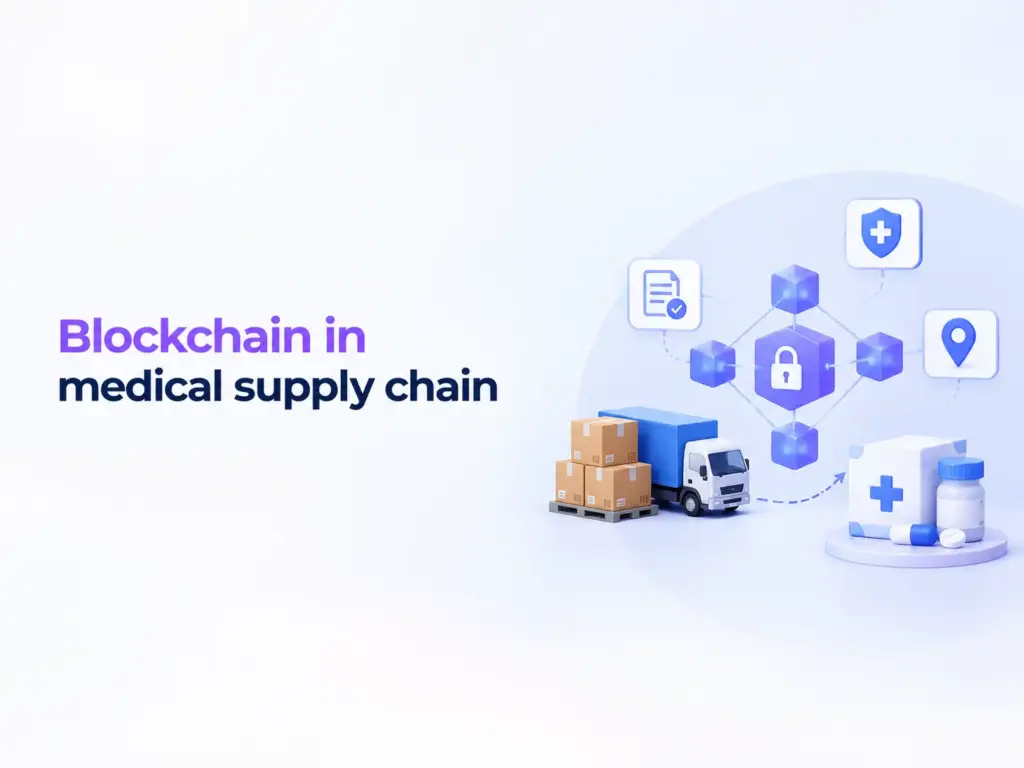
Blockchain in a medical supply chain is a shared, tamper-evident record of where each drug or device batch has been and who handled it. It helps most with counterfeit checks, recalls and audit trails across many companies. It does not fix bad data, and it is not needed when one company controls the whole chain.
Why do hospitals and drug makers look at blockchain at all?
Because no single company sees the full journey of a product. A drug moves from manufacturer to wholesaler to distributor to pharmacy, and each party keeps its own database. When something goes wrong, such as a recall or a suspected fake, people send emails and spreadsheets and wait days.
The scale of the fake-medicine problem is real. The World Health Organization estimated in 2017 that about 1 in 10 medical products in low- and middle-income countries is substandard or falsified. That figure is old, so check for the latest WHO number before you quote it.
In the US, the Drug Supply Chain Security Act (DSCSA) pushes the industry toward electronic, package-level tracing. Blockchain is one way to meet that goal, but it is not the only one. More on that below.
What does blockchain actually do in a medical supply chain?
It stores a shared log of events: a batch was made, shipped, received, stored at a given temperature, dispensed or recalled. Each new entry is linked to the one before it. Changing an old entry would be visible to everyone on the network, so the history is hard to quietly rewrite.
Think of it as a shared notebook that every trading partner can read, where nobody can erase a page without the others noticing.
A simple record for one batch might hold:
- GTIN (product code) and lot number
- Expiry date
- Serial numbers of packs
- Owner at each step, with time stamps
- Storage readings, if sensors are connected
Most medical chains use a permissioned blockchain, where only approved companies can join. Public chains like Ethereum are rarely a fit for drug data because of privacy and compliance limits.
How is it different from a normal shared database?
A shared database works well when one party runs it and everyone trusts that party. Blockchain makes sense when several companies that do not fully trust each other need one version of the truth, and nobody wants a single owner of the data.
| Question | Central database | Blockchain |
|---|---|---|
| Who controls the data? | One owner | Shared among members |
| Can history be changed quietly? | Yes, by an admin | Hard, changes are visible |
| Speed and cost | Faster and cheaper | Slower and costlier to run |
| Best when | One company, or one trusted operator | Many parties, low trust, audit needed |
If one operator already runs your network and all partners accept that, a well-built database may be the better answer. Be honest about this in your planning.
Where does blockchain help most?
It helps in four places, ordered here by how clear the payoff is.
Counterfeit and diversion checks. Each pack has a unique serial number. When a pharmacy or wholesaler scans it, the network can confirm the pack was made by the right company and has not been sold twice. MediLedger is a well-known example. It was set up by a group of drug industry companies, with names reported in the press including Pfizer, Genentech and AmerisourceBergen, to check product identifiers for DSCSA purposes.
Recalls. If a lot is bad, you want to know in minutes which pharmacies and hospitals received it. A shared event history turns a multi-day hunt into a query.
Cold chain proof. Vaccines and biologics must stay inside a temperature range. Sensors can send readings that get written to the shared record, so a hospital can see whether a shipment stayed in range before it accepts the box. This needs working IoT hardware, which is covered in the build section.
Automated payments and rebates. A smart contract is code that runs a rule when conditions are met. For example, release payment when a hospital confirms delivery and the temperature log is clean. This removes some manual invoice matching, but only after the data feeding the contract is trustworthy.
What are the limits and risks nobody mentions?
Blockchain records data. It does not check whether the data is true.
- Garbage in, garbage out. If a worker scans the wrong box or a sensor drifts out of calibration, the ledger will keep that error forever. You need good scanning habits, calibrated sensors and spot checks.
- Privacy. Patient data should not go on a shared ledger. Keep personal health information in your normal secure systems and write only product and batch events on-chain. Record hashes (digital fingerprints) if you need to prove a document existed.
- Network effect. A ledger with one member is just a slow database. Value appears only when your suppliers and buyers join.
- Integration work. Your ERP, warehouse system and pharmacy software all need to talk to the ledger. Most of the budget goes here, not into the blockchain itself.
- Governance. Someone must decide who can join, who pays for nodes and how disputes are handled.
- Regulation. Rules differ by country. The FDA’s DSCSA page is the starting point in the US, and requirements and deadlines have shifted over time.
Does blockchain solve DSCSA compliance by itself?
No. DSCSA asks trading partners to exchange product tracing data electronically in a secure, interoperable way. You can do that with or without blockchain. Many companies use standard barcodes and GS1 EPCIS event messages (a common format for “this lot was shipped, received, dispensed”) over regular systems.
Blockchain can sit on top of those standards as the shared record. Use the standards first, then decide if a ledger adds value. Reading the GS1 EPCIS standard is a good first step for any technical team.
When should you not use blockchain?
Skip it when:
- You run a small, closed supply chain with a few partners who already share a system.
- Your main problem is poor barcode scanning or missing master data.
- Partners will not join the network, or will not agree on who governs it.
- You only need an internal audit log. A database with signed, append-only records is cheaper.
Fix the basics first. A clean serialization setup and good data discipline deliver value with or without a ledger.
How do you build blockchain-based medical supply chain software?
Follow these steps in order. Each one has a clear output, so you can stop if the numbers do not work.
- Pick one problem. For example, recall speed for one product line, or cold chain proof for one route.
- Map the data. List every event, who creates it and which system holds it today. Align with GS1 identifiers and EPCIS events.
- Choose the network type. Most teams pick a permissioned platform such as Hyperledger Fabric. Check current options with your team.
- Decide what goes on-chain. Batch events and hashes only. Keep personal and commercial detail off-chain.
- Build the smart contracts and APIs. Start with a small set of rules: ownership transfer, receipt confirmation, recall flag.
- Connect sensors and systems. Cold chain needs data loggers or gateways, and this is where IoT app development skills matter. Your ERP and warehouse tools need connectors built through solid custom software development.
- Test hard. Smart contracts cannot be easily patched after deployment, so run unit tests, load tests and a security audit. A dedicated software quality assurance testing pass catches problems before they reach real shipments.
- Pilot with two or three partners. Run it next to your current process for a few months and compare results.
If you are unsure where to begin, a small MVP development project that covers one route and one partner is a safer way to learn than a full rollout.
How much does it cost to build?
These are planning ranges from general market experience, not quotes. Your price depends on integrations, number of partners and compliance scope.
| Scope | Typical range (USD) | Typical time |
|---|---|---|
| Single-route pilot, one product line | 40,000 to 90,000 | 3 to 5 months |
| Multi-partner traceability with ERP links | 90,000 to 180,000 | 5 to 9 months |
| Full network with IoT, analytics and audit tools | 180,000 to 300,000 or more | 9 to 14 months |
What moves the price:
- Number of systems to integrate
- Sensor hardware and gateways
- Security audit depth
- Number of network participants and nodes
- Regulatory documentation
Running costs are easy to forget. Plan for node hosting, monitoring, updates, partner onboarding and support. A common rule of thumb is to budget a yearly amount equal to a fair share of the build cost, but get your own number from a vendor.
What mistakes should you avoid?
- Starting with the technology instead of a measurable problem
- Putting personal health data on a shared ledger
- Building a network before partners have agreed to join
- Skipping data standards, then struggling to connect systems later
- Testing only the happy path and not failed scans, offline sensors or duplicate serials
- Having no plan for who owns governance after launch
What should you measure in a pilot?
Pick numbers before you start, so the pilot can say yes or no.
- Time to trace a lot from manufacturer to dispensing point
- Share of events captured without manual entry
- Number of mismatches found between partners’ records
- Cold chain exceptions caught before acceptance
- Cost per tracked pack, compared with your current process
If these do not improve against your baseline, stop or change the scope. That is a good result too, because you spent a pilot budget and not a full one.
Frequently asked questions
Is blockchain legal to use for drug tracking? Yes, in most places, if it meets local rules on data protection and tracing. In the US, DSCSA sets the tracing goals but does not require blockchain. Check your country’s regulator and keep patient data off the shared ledger.
Which blockchain platform is best for healthcare supply chains? Permissioned platforms such as Hyperledger Fabric are common because membership is controlled and privacy options are stronger. The right choice depends on your partners’ systems, your team’s skills and long-term support. Compare two or three in a pilot.
Can blockchain stop counterfeit medicines? It can make fakes easier to catch by letting anyone check a serial number against the manufacturer’s record. It cannot stop a fake pack that copies a real code unless duplicates are detected. It works best with serialization and scanning at every handoff.
How long does a pilot take? A focused pilot with one product line and two or three partners usually takes three to five months to build and a few more to measure. Time grows with the number of systems you need to connect.
Does it replace ERP or warehouse software? No. It sits beside them as a shared record of events. Your ERP still handles orders, stock and finance. The ledger helps partners agree on what happened to a batch, and the systems feed it data.
What is the first step for a small company? Start with serialization and GS1-standard data in your current systems. Then pick one pain point, such as recalls, and test whether a shared ledger reduces the time or cost. Do not build a network until partners agree to join.
Takeaways
Blockchain in medical supply chain is a good fit when many companies need to share one trusted history of a product, and a poor fit when one company already controls the data. Start with data standards, pick one clear problem, keep patient data off-chain and test with a small pilot before you scale.
If you want help scoping a pilot, the Luminoguru team can walk through your use case on the contact page.