 Mobile App Development
 Artificial Intelligence
 Software Development
 Generative AI
 QA & Testing
 UI/ UX Design
 IoT App Development
 Cloud App Development
 MVP Development
 SEO Services
 AI Code Optimization
 AI Integration Services
 Food Delivery
 Taxi Booking
 E-Commerce
 Mobile Game
 Logistics
 Real Estate
 Healthcare
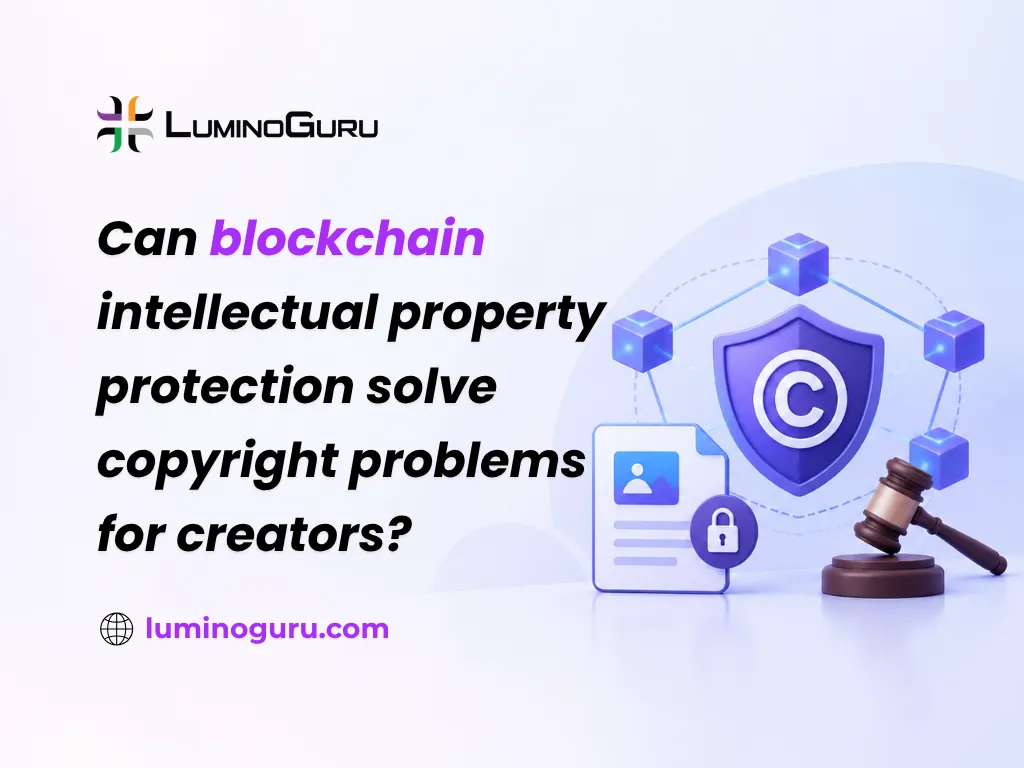
Blockchain intellectual property protection uses a shared, time stamped ledger to record when a creative work, patent idea or trademark use existed, so a creator can later prove that record has not been altered. It does not file a patent, grant a copyright or replace a court. It works alongside existing IP law, not instead of it.
In this guide:
- What problem blockchain actually solves for creators
- How blockchain records and protects IP, step by step
- Where real blockchain IP projects stand today
- Whether governments and IP offices actually use it
- Whether an NFT gives you copyright
- What to actually do about it, and the FAQs
What problem is blockchain actually solving for creators?
Creators have always struggled to prove two things: when they made something, and that the record of that moment has not been quietly changed. Blockchain is useful here because every entry on a public or permissioned ledger gets a timestamp and a cryptographic fingerprint that is extremely hard to alter without detection.
This matters most in disputes. If two people claim they created something first, a blockchain record with an earlier timestamp is strong supporting evidence. It is not automatic proof of ownership on its own, and it does not replace registering a patent, trademark or copyright where that registration gives you legal rights.
The World Intellectual Property Organization (WIPO) ran a real service built on exactly this idea. WIPO PROOF, launched in 2020, gave creators a “date- and time-stamped digital fingerprint of any file, proving its existence at a specific point in time,” according to WIPO’s own description of the tool. It is worth knowing that WIPO discontinued new token generation for this service on January 31, 2022, though tokens already issued remain valid and can still be verified. This history is a useful reminder: timestamping tools can come and go, but the underlying idea, proving a file existed at a certain time, keeps reappearing because it solves a real problem.
How does blockchain actually record and protect IP?
A blockchain IP system does three things: it timestamps a digital fingerprint of your work, it keeps that record from being changed quietly, and it lets other people check the record without needing to trust a single company. None of these steps file paperwork with a government IP office for you.
Here is the practical flow most platforms use:
- You upload a file, such as a document, image, design or audio track.
- The system creates a unique digital fingerprint (a hash) of that file. The actual file usually is not stored on the blockchain itself, since blockchains are expensive and slow for large files.
- The fingerprint and a timestamp are written to the blockchain.
- Later, anyone can run the same file through the same fingerprinting method and compare it to the stored record, confirming the file matches and existed at that time.
This is sometimes called a notarization or proof of existence service. It works well for proving a date. It does nothing to confirm you are the actual author, that your work does not infringe someone else’s rights, or that you hold a valid patent or trademark. Those still depend on normal legal processes.
Where do real blockchain IP projects stand today?
Several well known early projects in this space either shut down, got acquired, or quietly scaled back, which is worth knowing before you plan around any single platform. Treat blockchain IP tools as a supporting layer, not a long term guarantee that any one company will still exist in five years.
Mediachain Labs is a clear example. It was a Brooklyn based startup building a blockchain system to fix music attribution problems, including a decentralized database linking songs to rights holder information. According to TechCrunch’s reporting from April 2017, Spotify acquired Mediachain Labs and brought its team in house to work on connecting artists and rights holders to tracks on Spotify. Mediachain said it would open source its existing technology as the team moved over. The standalone product did not continue as an independent platform after that.
This does not mean the underlying idea failed. It means the specific vendor changed, and anyone who had built a process around using Mediachain as an outside service needed to adjust. The same caution applies to any blockchain IP vendor you consider today: ask what happens to your records if the company shuts down or gets acquired, and prefer platforms that let you export or independently verify your proof data.
Do governments and IP offices actually use blockchain?
Some do, in pilot and research form, but blockchain has not replaced standard registration processes anywhere. The European Union Intellectual Property Office (EUIPO) has run its Blockathon programme for several years, bringing together IP offices, companies and developers to test anti-counterfeiting and IP management ideas built on blockchain, including proof of concept projects presented at its EU Blockathon Forum events.
These are pilots and competitions, not live replacements for filing a patent or trademark application. If you are relying on blockchain for IP protection in a specific country, check that country’s actual IP office procedures rather than assuming blockchain evidence will be accepted the same way everywhere. Courts and IP offices in different countries are still working out how much weight to give blockchain timestamps as evidence.
Does an NFT give you copyright in the underlying work?
No, not automatically. Buying an NFT linked to a piece of art, music or writing usually gives you ownership of that specific token, not the copyright in the creative work itself.
According to legal analysis from the law firm Jones Day, an NFT “simply proves that the buyer is the owner of” the specific digital asset it represents. The creator typically keeps all copyright and creative rights, including the right to make and sell copies, unless the sale terms explicitly transfer or license those rights. In some cases, buying an NFT gives you only a limited license, such as rights to display the work personally, and nothing more. Jones Day’s analysis uses the Spice DAO case as an example: the buyer purchased a physical script book through an NFT sale, not the copyright to the story or script itself.
If you plan to sell NFTs tied to your creative work, or you are building a platform that does this for others, write the licensing terms in plain language and have a lawyer review exactly what rights transfer with each sale. Vague terms are the single biggest source of disputes in this space.
What should a business actually do with blockchain IP tools today?
Use blockchain as one extra layer of evidence, not your only protection. Keep registering patents, trademarks and copyrights through your country’s normal IP office wherever that option exists, because that is still what courts rely on most heavily.
A sensible approach for most businesses:
- Register formal IP rights (patents, trademarks, copyrights) through your national IP office first, since this remains the strongest legal protection available.
- Use blockchain timestamping as supporting evidence for creation dates, drafts, designs or internal research, especially for material that takes time to formally register.
- Keep a clear internal log of who created what and when, separate from any blockchain service, so you are not dependent on one vendor.
- Review licensing terms carefully before buying, selling or minting any NFT tied to creative work.
- Avoid platforms that are vague about where your actual files are stored and how you can independently verify your proof later.
If your business is building a product around IP protection, licensing or content attribution, the underlying system usually needs careful architecture work, not just a blockchain feature bolted onto an app. A team with real AI and emerging technology development experience can help you decide which parts actually need a blockchain and which are better served by a normal secure database. For platforms that also issue licenses or run marketplaces for creators, connecting that system correctly with payment and verification tools is where most of the real engineering work happens, which is where solid software development services matter more than the blockchain layer itself.
Frequently asked questions
Does putting my work on a blockchain register my copyright?
No. Blockchain can create evidence that your file existed at a certain time, but it does not file anything with a copyright office. In most countries, copyright exists automatically once you create an original work, though formal registration still strengthens your legal position in a dispute.
Can blockchain evidence hold up in court?
It can be used as supporting evidence of a creation date, but courts in most countries are still developing clear standards for how much weight to give it. Treat it as one piece of evidence alongside other records, not a replacement for registering your IP where registration is available.
What happened to WIPO PROOF?
WIPO PROOF was a timestamping service WIPO launched in 2020. WIPO stopped issuing new tokens for the service on January 31, 2022, though previously issued tokens remain valid and verifiable. Its history shows that even official timestamping tools can be discontinued, so keep your own backup evidence.
If I buy an NFT of an artwork, do I own the copyright?
Usually not. Legal analysis from firms including Jones Day confirms that NFT ownership typically covers only the token itself, and the original creator keeps copyright unless the sale terms specifically transfer or license those rights. Always read the licensing terms before assuming you can reproduce or sell copies.
Is blockchain IP protection only useful for big companies?
No. Independent creators, such as writers, photographers and musicians, can use low cost timestamping tools to build a record of drafts and creation dates over time. The bigger investment, building a custom platform or marketplace around blockchain IP, is where cost and complexity rise, and that is more relevant for businesses than individuals.
Should a startup build its own blockchain IP platform?
Only if blockchain solves a specific, real problem for your users, such as proving creation order across many contributors or running an IP marketplace with built in licensing. For most teams, a small MVP development project testing demand with a simple timestamping feature is a safer first step than building a full blockchain platform upfront.
Takeaways
Blockchain intellectual property protection gives creators a useful way to timestamp and prove a work existed at a given point in time, but it works alongside formal registration, not instead of it. Treat early blockchain IP startups as a cautionary example of vendor risk, read NFT licensing terms carefully, and use blockchain as one layer of evidence rather than your entire IP strategy.
If you are exploring whether a blockchain based IP or licensing platform makes sense for your business, the Luminoguru team is happy to talk through your use case on the contact page.