 Mobile App Development
 Artificial Intelligence
 Software Development
 Generative AI
 QA & Testing
 UI/ UX Design
 IoT App Development
 Cloud App Development
 MVP Development
 SEO Services
 AI Code Optimization
 Food Delivery
 Taxi Booking
 E-Commerce
 Mobile Game
 Logistics
 Real Estate
 Healthcare
In today’s mobile-first world, businesses are under constant pressure to deliver high-quality apps faster, across multiple platforms, and within controlled budgets. This demand has made cross-platform app development a strategic priority rather than an optional approach. Among the many tools and technologies available, Flutter and React Native consistently stand out as the leading frameworks powering modern cross-platform apps.
But why exactly do these two frameworks dominate the ecosystem? What makes them preferable over traditional native development or other mobile app frameworks? And how do they compare when evaluated through performance, scalability, development speed, and long-term maintainability?
This blog explores why Flutter and React Native lead cross-platform app development, how they differ, and how businesses can choose the right framework for their mobile strategy.
Understanding Cross-Platform App Development
Cross-platform app development is the process of building a single mobile application that runs on multiple operating systems—primarily Android and iOS—using a shared codebase.
Instead of creating two separate native apps (Swift/Objective-C for iOS and Kotlin/Java for Android), developers write one set of code and deploy it across platforms. This approach significantly reduces development time, cost, and effort while maintaining consistent user experiences.

Key Advantages of Cross-Platform Apps
- Faster time-to-market
- Reduced development and maintenance costs
- Code reusability across platforms
- Consistent UI and functionality
- Easier updates and feature rollouts
These advantages explain why cross-platform apps are now widely adopted across industries such as fintech, healthcare, eCommerce, logistics, and SaaS.
Read More: Is Flutter Good for Web Development?
The Rise of Modern Mobile App Frameworks
Earlier cross-platform solutions struggled with performance issues and limited native access. However, modern mobile app frameworks like Flutter and React Native have reshaped this narrative.
Both frameworks are backed by tech giants—Google (Flutter) and Meta (React Native)—ensuring long-term support, rapid innovation, and robust ecosystems. They bridge the gap between performance and productivity, offering near-native experiences without the overhead of native development.
Flutter App Development: A Modern UI-First Approach
What Is Flutter?
Flutter is an open-source UI toolkit developed by Google that enables developers to build natively compiled applications for mobile, web, and desktop from a single codebase. Flutter app development uses the Dart programming language and focuses heavily on UI consistency and performance.
Why Flutter Excels in Cross-Platform App Development
1. Single Codebase with Consistent UI
Flutter renders its own UI components using a high-performance rendering engine. This ensures identical UI behavior across platforms, eliminating inconsistencies caused by platform-specific UI components.
2. Near-Native Performance
Unlike older hybrid solutions, Flutter compiles directly to native ARM code. This removes the JavaScript bridge overhead, delivering smooth animations and high-performance rendering—ideal for graphics-heavy cross-platform apps.
3. Rich Widget Library
Flutter offers a comprehensive set of customizable widgets that follow Material Design (Android) and Cupertino (iOS) guidelines. Developers can easily create visually appealing and responsive interfaces.
4. Hot Reload for Faster Development
Flutter’s hot reload allows developers to instantly see code changes without restarting the app, dramatically improving development speed and productivity.
5. Growing Ecosystem and Community
Flutter’s ecosystem is expanding rapidly, with plugins supporting APIs, sensors, payment gateways, and backend integrations—making Flutter app development suitable for both MVPs and enterprise-grade applications.
React Native App Development: JavaScript-Driven Efficiency
What Is React Native?
React Native is an open-source framework created by Meta that enables developers to build mobile apps using JavaScript and React. It allows code sharing across platforms while rendering UI using native components.
Why React Native Leads Cross-Platform Apps
1. Native Look and Feel
React Native uses platform-specific UI components, ensuring apps feel truly native on both Android and iOS.
2. Massive JavaScript Ecosystem
Since React Native is built on JavaScript, developers gain access to one of the largest developer ecosystems in the world. This accelerates development and simplifies hiring.
3. Code Reusability Across Platforms
A large portion of business logic can be shared across platforms, significantly reducing development effort in cross-platform app development projects.
4. Strong Community Support
React Native benefits from an extensive open-source community, mature libraries, and continuous improvements driven by real-world usage at scale.
5. Faster Iterations for Business Apps
For apps focused on data handling, dashboards, or content-driven experiences, React Native app development offers rapid iteration cycles and flexibility.
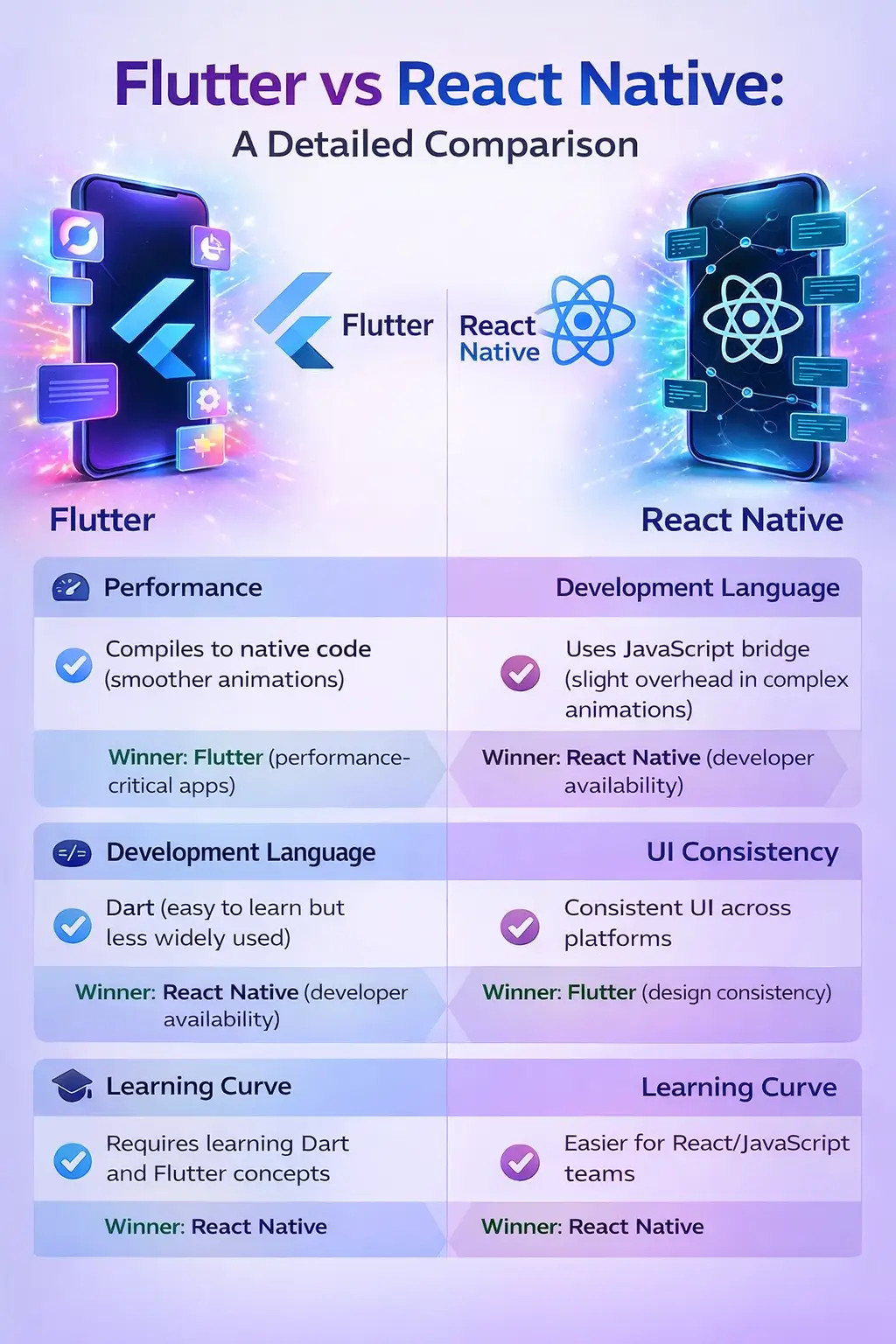
Flutter vs React Native: A Detailed Comparison
Understanding Flutter vs React Native is essential when selecting the right framework for your cross-platform app strategy.
1. Performance
- Flutter: Compiles directly to native code, offering smoother animations and faster UI rendering.
- React Native: Relies on a JavaScript bridge, which may introduce slight overhead in complex animations.
Winner: Flutter (performance-critical apps)
2. Development Language
- Flutter: Dart (easy to learn but less widely used)
- React Native: JavaScript (extremely popular and widely adopted)
Winner: React Native (developer availability)
3. UI Consistency
- Flutter: Consistent UI across platforms
- React Native: Platform-specific UI variations
Winner: Flutter (design consistency)
4. Learning Curve
- Flutter: Requires learning Dart and Flutter-specific concepts
- React Native: Easier for teams familiar with React or JavaScript
Winner: React Native
5. Ecosystem Maturity
- Flutter: Rapidly growing ecosystem
- React Native: More mature with extensive third-party libraries
Winner: React Native
You May Like to Know: Top 15 Web Development Companies in 2025
Use Cases Where Flutter and React Native Shine
Ideal Use Cases for Flutter App Development
- Apps with complex UI and animations
- MVPs requiring fast UI iteration
- Apps needing identical design across platforms
- Fintech, healthcare, and IoT dashboards
Ideal Use Cases for React Native App Development
- Content-driven apps
- Enterprise business apps
- Social networking platforms
- Apps leveraging existing React web codebases
How Cross-Platform Apps Reduce Development Costs
One of the primary reasons businesses adopt Flutter and React Native is cost efficiency.
Cost Benefits of Cross-Platform App Development
- 30–40% reduction in development costs
- Lower maintenance overhead
- Faster feature rollouts
- Smaller development teams
Instead of maintaining separate native teams, businesses can streamline operations using a unified cross-platform approach.
Scalability and Long-Term Maintenance
Both Flutter and React Native support scalable architectures when implemented correctly.
- Modular code structures
- Clean architecture patterns
- Backend-agnostic integrations
- Easy CI/CD integration
When paired with modern DevOps practices, these mobile app frameworks support long-term growth without performance degradation.
Security Considerations in Cross-Platform Apps
Security is often a concern in cross-platform app development, but both frameworks offer strong protection when best practices are followed:
- Secure API communication
- Encrypted local storage
- Role-based authentication
- Secure third-party plugin usage
The framework choice matters less than how securely the app is architected.
The Future of Cross-Platform App Development
The future of cross-platform apps is promising, with Flutter and React Native leading innovation in areas such as:
- Web and desktop app support
- AI-powered UI components
- Improved performance engines
- Better tooling and testing frameworks
As businesses demand faster innovation cycles, cross-platform app development will continue to replace traditional native-only approaches.

Choosing Between Flutter and React Native
There is no universal “best” framework. The right choice depends on:
- Project complexity
- Performance requirements
- Developer expertise
- Timeline and budget
- Long-term scalability goals
Both Flutter app development and React Native app development offer mature, reliable, and future-ready solutions for building scalable cross-platform apps.
Read More: Choosing the Right Mobile Development Platform for Your Business Needs
Conclusion
Flutter and React Native dominate the cross-platform app development landscape because they successfully balance performance, productivity, scalability, and cost efficiency. While Flutter excels in UI consistency and performance, React Native shines in ecosystem maturity and developer accessibility.
As mobile technology evolves, businesses that invest in the right mobile app frameworks will gain a competitive edge by delivering high-quality cross-platform apps faster and more efficiently.
Choosing between Flutter vs React Native isn’t about trends—it’s about aligning technology with business goals.
FAQs
1. Why is cross-platform app development ideal for modern businesses?
Cross-platform app development allows businesses to build Android and iOS apps using a single codebase, reducing costs, speeding up launches, and ensuring consistent user experiences across platforms without compromising performance or scalability.
2. Which is better for cross-platform apps: Flutter or React Native?
Both Flutter and React Native are powerful mobile app frameworks. Flutter offers superior UI performance and consistency, while React Native excels in ecosystem maturity and JavaScript flexibility. The best choice depends on app complexity and business goals.
3. How does Flutter app development improve time-to-market?
Flutter app development uses a single codebase, rich UI widgets, and hot reload features, enabling faster development cycles, quick iterations, and efficient testing—making it ideal for startups and enterprises aiming for rapid app launches.
4. Why do enterprises prefer React Native app development?
React Native app development allows enterprises to reuse JavaScript and React expertise, integrate with existing systems, and build scalable cross-platform apps with near-native performance and long-term maintainability.
5. Are cross-platform apps scalable for future growth?
Yes, modern cross-platform apps built with Flutter or React Native support modular architectures, cloud integrations, and CI/CD pipelines, ensuring scalability, performance optimization, and easy feature expansion as business needs evolve.
6. How do mobile app frameworks reduce development costs?
Mobile app frameworks like Flutter and React Native reduce development costs by sharing code across platforms, minimizing maintenance efforts, lowering team size requirements, and accelerating updates—making cross-platform app development highly cost-efficient.