 Mobile App Development
 Artificial Intelligence
 Software Development
 Generative AI
 QA & Testing
 UI/ UX Design
 IoT App Development
 Cloud App Development
 MVP Development
 SEO Services
 AI Code Optimization
 AI Integration Services
 Food Delivery
 Taxi Booking
 E-Commerce
 Mobile Game
 Logistics
 Real Estate
 Healthcare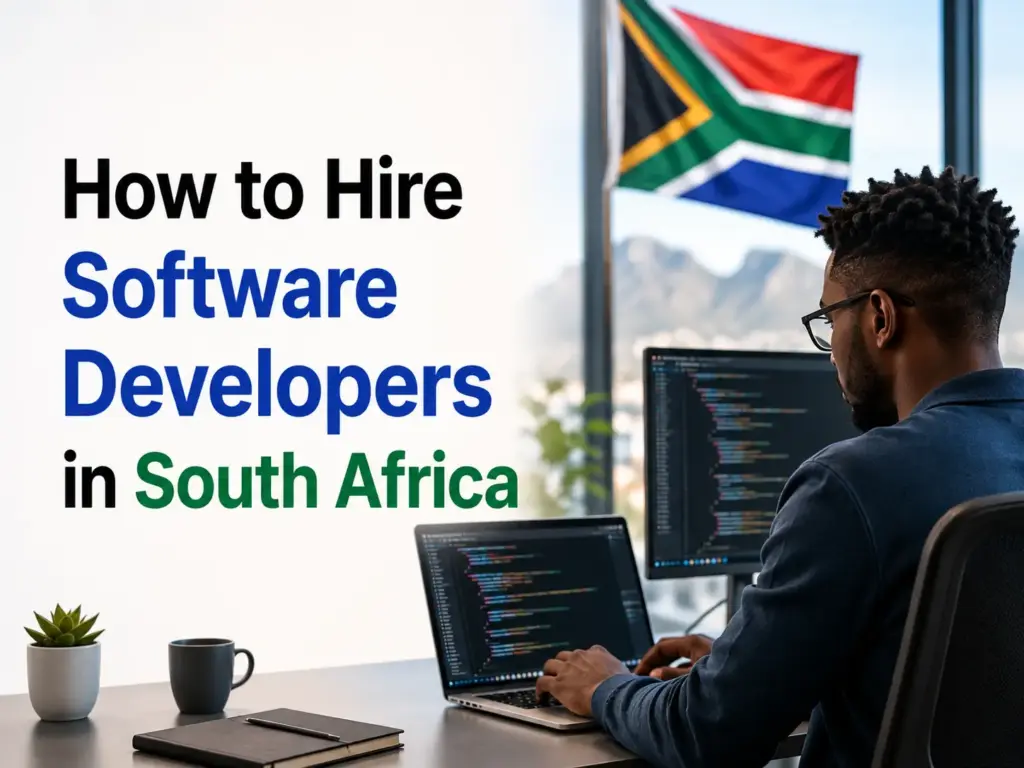
South Africa has quietly become one of the most serious software development markets on the continent. With over 120,000 professional developers, strong English communication, a time zone that works for Europe and the Middle East, and rates well below the US and UK, more international companies are choosing to outsource their software development here than ever before.
But knowing the market exists and actually hiring from it well are two different things. This guide covers the practical side of it: what it costs, which hiring model fits your situation, what to look for in a developer or team, and the mistakes that slow most companies down before they even get started.
Why South Africa Is Worth a Serious Look
Before getting into the how, it helps to understand why this market has gained traction with international companies across Europe, the Middle East, and the US.
The cost difference is significant. A senior developer in South Africa typically earns between $36,000 and $56,000 a year. The equivalent in the US usually costs $150,000 to $200,000. That gap is real, and it stays real even after you factor in the cost of managing a remote team properly.
English is the working language. There is no communication barrier to navigate. Sprint calls, code reviews, documentation, and escalations all happen in English by default.
The time zone works. South Africa runs on UTC+2, which gives near full overlap with the UK, Central Europe, and the Middle East. US East Coast teams have a 6 to 7 hour gap, which is manageable with good async workflows but worth planning for.
The talent base is mature. Universities like the University of Cape Town, Stellenbosch, and Wits produce strong computer science graduates. The banking and fintech sector in Cape Town and Johannesburg has produced a large pool of engineers with real enterprise experience. This is not a market of fresh graduates filling cheap seats. It is a market with genuine depth across mobile, backend, cloud, and increasingly AI.
Cape Town leans toward product-focused engineering and startup culture. Johannesburg has stronger roots in financial services and enterprise systems. Both cities have senior talent worth hiring.
Step by Step: How to Hire Software Developers in South Africa
Most companies that run into trouble with offshore hiring do so in the first few weeks, not because they picked the wrong country but because they skipped the groundwork. Here is the process that actually works.
Step 1: Define the Project Before You Look at Anyone
This sounds obvious. Most companies skip it anyway.
Before you write a job post or brief an agency, nail down what you are actually building. What is the tech stack? What are the core features? Does the product touch personal data? What does done look like at each phase?
Getting this on paper before talking to any developer turns a vague hiring request into something a candidate or partner can actually respond to meaningfully. It also tells you what kind of help you need: a specialist plugging into an existing team, or a full team owning delivery end to end.
If your product handles personal data, compliance needs to be part of the brief from the start. South Africa’s POPIA law mirrors a lot of what GDPR requires in Europe. Any serious development partner should already be building with both in mind.
Step 2: Choose the Right Hiring Model
Not every engagement looks the same. The right model depends on how much control you want, how long you need the team, and how much internal capacity you have to manage the relationship.
| Hiring Model | Control | Best Suited For |
|---|---|---|
| Freelancers | Low | Small, short, well-defined tasks |
| Staff Augmentation | High | Adding senior developers to an existing team quickly |
| Dedicated Development Team | High | Ongoing product work with a stable embedded team |
| Software Development Company | Shared | Full project delivery without in-house tech leadership |
For most companies entering the South African market for the first time, staff augmentation is the lower-risk starting point. You get experienced developers and real control over output without committing to a full team before you have tested the relationship. Dedicated teams make more sense for longer-term products where consistency and accumulated product knowledge matter.
Step 3: Go Beyond the Resume
Certificates and a polished LinkedIn profile tell you very little about how someone actually performs under pressure.
Ask to see live products, not mockups or slides. Talk to at least one past client directly if you can arrange it. Look for evidence of ownership, not just task completion. A developer who can walk you through an architectural decision they made and the tradeoffs involved tells you far more than one who can list frameworks on a CV.
For senior hires or team engagements, this step deserves real time. A 15-minute call with a past client usually tells you more than any case study page.
Step 4: Set Communication Expectations Before Day One
Remote hiring succeeds or fails on communication, and most problems start in the first two weeks because nobody agreed on the basics upfront.
Before work starts, agree on how often you will meet, how progress gets shared, who owns which decisions, and what the escalation path looks like when something goes wrong. South Africa’s time zone makes live communication easier than most offshore markets. Use that advantage by scheduling real syncs rather than relying entirely on async updates.
A fixed sprint cadence with a single point of contact on each side handles most of the friction before it becomes a real problem.
Step 5: Put Everything in Writing Before Work Starts
Response times, delivery expectations, quality standards, and what happens if a deadline slips should all be documented before the first sprint begins. An SLA is not bureaucracy. It is the thing you both point to when there is disagreement, which saves weeks of difficult conversations later.
Set a 30-day check-in to catch friction early while it is still cheap to fix.
What Types of Developers Can You Hire?
South Africa’s talent pool covers a much wider range than basic web development.
Mobile app developers working in Swift for iOS, Kotlin for Android, and cross-platform frameworks like Flutter and React Native. Strong mobile talent exists across both Cape Town and Johannesburg.
Full-stack developers who handle both backend and frontend, typically Node.js or Python paired with a modern frontend framework. A good fit for lean teams that need one person to own a feature end to end without handoff delays.
Backend and cloud engineers specializing in AWS and Azure, CI/CD pipelines, and scalable infrastructure. This role matters more than most companies expect once a product moves past its first few thousand users.
AI and machine learning developers who build predictive models, recommendation systems, and data pipelines. Demand has grown fast, driven largely by the fintech sector, which has produced engineers with real-world experience applying these capabilities to business problems rather than academic exercises.
Generative AI developers covering LLM integration, retrieval-augmented generation, and AI features embedded in existing products. One of the fastest-growing specialties in the market right now.
QA and automation engineers who catch expensive bugs before they reach production. Often underestimated in the hiring process, but consistently high value for any product with real users.
How Much Does It Cost?
Rates depend on seniority, specialization, and whether you are hiring through a local partner or directly. Here are realistic benchmarks based on current market data:
| Experience Level | Approximate Annual Salary (USD) |
|---|---|
| Entry level (0 to 2 years) | $15,000 to $22,000 |
| Mid level (3 to 6 years) | $22,000 to $36,000 |
| Senior (7 to 10 years) | $36,000 to $56,000 |
| Lead or senior specialist (10+ years) | $56,000 to $78,000+ |
A few things that move these numbers:
Specialization matters a lot. Cloud, DevOps, and AI engineers consistently sit at the top of the pay scale. General frontend roles usually come in lower.
Location within the country. Cape Town and Johannesburg command the highest rates. Demand and cost of living are both higher there than in smaller tech hubs.
Remote vs local rates. Developers billing international clients directly often earn two to three times the local market average. If you are hiring remotely, budget for the international rate, not the local one.
Team mix. A blended team with a couple of senior developers supported by strong mid-level engineers typically delivers better value than an all-senior bench for most project types.
Hidden costs. A rate that includes a dedicated project manager, QA coverage, and structured reporting runs higher than a bare developer rate. But it usually saves money in rework and management overhead over the course of a project.
Skills to Look for Beyond the Tech Stack
The technical stack is table stakes. These are the qualities that actually predict whether a developer or team will deliver.
A real track record of shipped products, not just contributions to internal tools or incomplete projects. Ask to see live work.
Architectural thinking: someone who designs for how the system needs to scale, not just how to get the current feature working.
Security by default: data protection and secure coding built into how they work, not added as an afterthought before a compliance review.
Clear written and spoken communication, especially important when you are working across time zones and some of the day will always be async.
POPIA and GDPR familiarity for any product handling personal data, which in practice is almost every serious commercial product.
Questions to Ask Before You Sign Anything
Run through these before committing to any developer or development company, whether that is a freelancer or a full dedicated team.
On technical fit:
- Can you walk me through a product you built end to end, not just a feature you contributed to?
- What direct experience do you have with our specific tech stack, not just something adjacent to it?
- How do you handle code reviews and technical documentation on an ongoing project?
On process and delivery:
- What does a normal sprint or delivery cycle look like for your team?
- How do you handle scope changes once a project is already underway?
- What happens if a key developer leaves partway through the engagement?
On compliance and security:
- How do you handle data protection under POPIA and GDPR?
- Do you hold ISO 27001 or ISO 9001 certifications?
- Who owns security testing and at what point in the build does it happen?
On cost and commercials:
- Is your rate fully loaded, or are there extra costs for QA, project management, or infrastructure?
- What is covered in the SLA and what happens if a deadline is missed?
- How do you handle currency and payment terms for an international client?
These questions take an extra hour upfront. They consistently save weeks of cleanup later.
Common Mistakes That Slow Companies Down
Hiring on price alone. The cheapest quote almost always becomes the most expensive rework. Evaluate quality and fit first. Cost is a secondary filter, not the primary one.
Skipping the trial project. A short paid trial of two to four weeks tells you more about communication, delivery, and culture fit than any interview process. Make it a standard part of your evaluation.
Ignoring the time zone gap for US teams. European teams get near full overlap. US East Coast teams have a 6 to 7 hour gap. Plan async workflows from the start rather than assuming availability will sort itself out.
No written SLA. Expectations around timelines, quality, communication, and what happens when something goes wrong should be documented before any work begins. Figuring it out after a deadline is missed is significantly more painful.
Treating a portfolio as proof enough. A quick call with a past client tells you far more than a case study written by the same company whose work you are evaluating.
What It Looks Like When It Works
We built the Postkodes Parcel Handling Solution for a logistics company that needed reliable parcel routing and tracking across a distributed network.
The result: a backend-heavy platform with complex integrations that holds up under real operational load – not just in testing.
That is what properly scoped, well-managed software development produces. A system built to last, not just to launch.
Frequently Asked Questions
How much does it cost to hire a software developer in South Africa?
Entry-level developers typically cost between $15,000 and $22,000 a year. Senior developers with 7 to 10 years of experience range from $36,000 to $56,000. Specialized skills like generative AI and cloud architecture sit at the higher end of these ranges. Developers working directly for international clients often charge above local averages.
Is South Africa a good market to outsource software development to?
For most companies, yes. You get English-first communication, a large pool of trained engineers with real enterprise experience, a time zone that works for Europe and the Middle East, and rates well below the US or Western Europe. The market has genuine depth, particularly in mobile, backend, and increasingly AI.
Which hiring model works best for a startup versus an enterprise?
Startups generally do well with staff augmentation or a small dedicated team. You get senior talent and real control without the overhead of building an HR function. Enterprise teams often use a mix: an internal core team plus a staff augmentation or dedicated development partner for specialized or fast-moving projects.
How long does it take to hire a developer or team?
With an established partner, a single senior developer can often be placed within 48 hours. Building a full dedicated team usually takes one to two weeks, since it involves matching multiple roles and skill sets rather than a single hire.
Do I need a local legal entity in South Africa to hire developers there?
No. If you are working through a staffing partner, a dedicated team model, or a development company, they handle local employment and payroll on their end. A local entity is only necessary if you plan to hire developers directly as full-time employees on your own payroll.
Which city has stronger developer talent: Cape Town or Johannesburg?
It depends on what you need. Cape Town leans toward product-focused engineering and startup experience. Johannesburg has deeper strength in financial services and enterprise systems. Both have strong senior talent at the top end of the market.
Can I start with a small pilot before committing to a larger team?
Yes, and for a first engagement in a new market, it is usually the smarter move. A well-specified pilot lets you evaluate how a developer or team actually works before committing the full budget. Most staff augmentation and dedicated team models are designed to flex this way.
How do I verify the quality of a South African development company?
Look for ISO 9001 and ISO 27001 certifications. Ask to see live products in their portfolio, not just slides or screenshots. Talk to at least one past client directly. A 15-minute reference call tells you more about how a team operates than any case study on their website.