 Mobile App Development
 Artificial Intelligence
 Software Development
 Generative AI
 QA & Testing
 UI/ UX Design
 IoT App Development
 Cloud App Development
 MVP Development
 SEO Services
 AI Code Optimization
 AI Integration Services
 Food Delivery
 Taxi Booking
 E-Commerce
 Mobile Game
 Logistics
 Real Estate
 Healthcare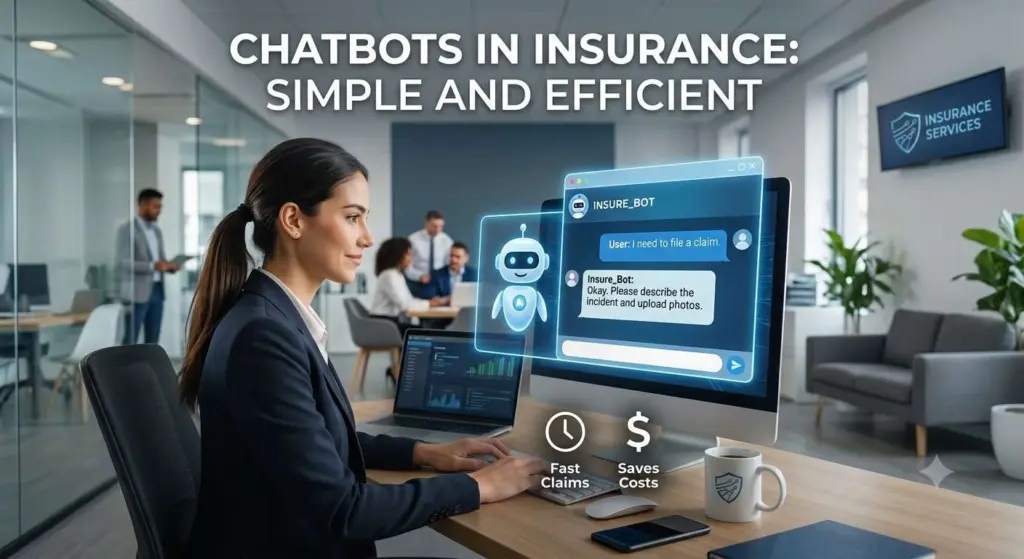
Picture this. It’s 11 pm on a Sunday. Someone’s car just got hit in a parking lot. They’re stressed, they don’t know if they’re covered, and calling an agent isn’t an option because, well, nobody’s picking up at 11 pm on a Sunday.
This is exactly the moment where an insurance chatbot steps in. No hold music. No “please stay on the line.” Just a quick chat that tells them what’s covered, what documents to upload, and what happens next.
That one small interaction sums up why insurance companies across the world are investing heavily in chatbots. It’s not about looking modern or ticking a “we use AI” box. It’s about being there for customers exactly when they need help the most.
In this blog, we’ll break down what insurance chatbots actually do, why insurers are adopting them so fast, real examples of how they’re being used, what it costs to build one, and the challenges you should know about before starting. No jargon, no fluff just a clear, honest look at the topic.
Why Insurance Companies Can’t Ignore Chatbots Anymore
Insurance, as an industry, has always had a bit of a reputation problem. Slow claims, long forms, confusing policy language, and support lines that keep you waiting forever. Customers today simply won’t tolerate that anymore.
They’re used to instant replies from every other app on their phone food delivery, banking, shopping. So when it comes to something as important as their car, health, or home insurance, they expect the same speed and simplicity.
That’s the real reason chatbots have moved from being a “nice-to-have” to a “must-have” for insurers. They let companies answer questions, process claims, and guide customers through policies without making them wait for a human to be available.
And it’s not just about customer support anymore. Insurers are now using chatbots for things like helping new customers pick the right plan, assisting agents with paperwork, and even catching suspicious claims before they turn into bigger problems.
What Chatbots Actually Do for Insurance Companies
Let’s keep this simple. Here’s what a well-built insurance chatbot can genuinely help with:
They’re available all the time. No lunch breaks, no weekends off. Whether someone wants to check their premium at 2 am or file a claim on a public holiday, the chatbot is there.
They speed up claims. Instead of filling out long forms and waiting days for a callback, customers can report an incident, upload photos, and get a claim number in minutes.
They cut down costs. Every question a chatbot answers is one less call for a human agent to handle. Over time, this adds up to serious savings on support staff and call center expenses.
They personalize the experience. A good chatbot built on solid AI development doesn’t just answer generic questions it looks at a customer’s policy, past behavior, and needs to suggest relevant plans or reminders.
They help convert leads into customers. When someone’s browsing an insurance website, a chatbot can answer their doubts on the spot and guide them toward buying a policy instead of letting them leave the site confused.
They free up human agents. With routine questions handled by the bot, agents get more time to focus on complicated claims and customers who genuinely need a human touch.
They keep things consistent. A chatbot won’t have a bad day and give a customer wrong information. Every answer comes from the same approved source, every single time.
They talk to everyone, in their language. Multilingual chatbots mean insurers aren’t limited to serving customers who speak just one language.
They scale without breaking. Whether it’s ten conversations happening at once or ten thousand during a natural disaster, the chatbot handles the load without a dip in quality.
Real Ways Insurance Companies Are Using Chatbots Today
Theory is fine, but let’s look at how this plays out in the real world.
Helping people choose the right policy. Buying insurance can be confusing too many plans, too many terms nobody understands. A chatbot can ask a few simple questions about a person’s needs and instantly suggest a policy that fits, along with a quote. This turns what used to be a 20-minute phone call into a two-minute chat.
Filing the first claim report. When something goes wrong an accident, theft, property damage the first step is reporting it. Chatbots make this painless by asking for the basic details, requesting photos, and creating a claim ticket automatically, so the customer isn’t stuck waiting for someone to pick up the phone.
Tracking claim status. “Where’s my claim?” is one of the most common questions insurance companies get. A chatbot can pull this information instantly instead of making the customer wait for an email or a callback.
Explaining health coverage. Health insurance is famously confusing. Chatbots can help members understand what’s covered, find nearby hospitals in their network, and get answers about pre-approvals without digging through a policy document.
Qualifying sales leads. Not every website visitor is ready to buy. A chatbot can have a natural conversation, figure out what a visitor actually needs, and only pass on the serious, ready-to-buy leads to a sales agent saving everyone’s time.
How to Actually Build an Insurance Chatbot
If you’re considering building one for your insurance business, here’s a practical roadmap that keeps things grounded.
Start with a clear problem, not a shiny feature. Are you trying to reduce call center volume? Speed up claims? Improve policy sales? Pick a focused goal instead of trying to solve everything at once.
Map out the conversations. Think through the actual questions customers ask “Am I covered for this?”, “How do I renew?”, “Where’s my claim?” and design simple, clear conversation flows around them.
Connect it to your existing systems. A chatbot that can’t access your policy database, claims system, or CRM is just a glorified FAQ page. Real value comes from integration with your core insurance software.
Train it on your actual policies. Train it on your actual policies. Using generative AI development, the chatbot learns from your real documents policy wording, claim procedures, FAQs so it gives accurate answers instead of generic ones.
Take security seriously from day one. Insurance chatbots deal with sensitive personal and financial data. Encryption, secure logins, and compliance with data protection laws aren’t optional extras they’re the foundation.
Test it against real scenarios. Before launch, run the chatbot through actual customer situations messy claims, angry customers, edge cases not just the happy path.
Launch, then keep improving. Once it’s live, track how well it’s performing, where customers get stuck, and keep feeding it new information as your policies and processes evolve.
What Does It Cost to Build One?
This is usually the first question business owners ask, and fair enough budgets matter.
The honest answer is: it depends. A simple chatbot that answers FAQs, gives basic quotes, and tracks claim status will cost far less than a full-scale AI assistant that’s deeply integrated with your policy, claims, and CRM systems, handles underwriting support, and includes fraud detection.
Broadly speaking, you’re looking at a wide range from a modest investment for a basic customer support bot to a significantly larger one for an enterprise-grade AI assistant with advanced capabilities. The final number depends on:
- How many features and use cases you want covered
- How many internal systems it needs to connect with
- Whether you need multilingual support
- The level of security and regulatory compliance required
- Ongoing costs like hosting, AI usage, and ongoing maintenance
A good development partner will walk you through where your money is actually going instead of just handing you a flat number.
Challenges to Watch Out For
Building a chatbot isn’t just plugging in an AI model and calling it done. Here are common roadblocks and how to handle them:
Data scattered across old systems. Many insurers still run on legacy software that doesn’t talk to each other easily. The fix is proper integration planning from the start, not an afterthought.
Wrong or outdated answers. If the chatbot’s knowledge base isn’t accurate or current, it’ll give customers wrong information which is worse than no chatbot at all. Keep the knowledge base updated and let the bot hand off tricky questions to a human.
Privacy concerns. People are (rightly) cautious about sharing personal and financial details with a bot. Strong encryption and transparent data practices help build that trust.
Confusing conversations. If customers can’t figure out what to type or the bot keeps misunderstanding them, they’ll give up fast. Keep the design simple and always offer an easy way to reach a human.
Complex policy language. Insurance is full of technical terms and exceptions. The chatbot needs to explain things in plain language, not just repeat legal jargon back at customers.
Final Thoughts
Chatbots in insurance aren’t about replacing people they’re about removing the friction that makes insurance feel like a hassle. A customer who gets a fast, clear answer at 11 pm on a Sunday is a customer who trusts your company a little more.
The insurers doing this well aren’t just installing a chatbot and walking away. They’re treating it as an extension of their customer service team one that’s trained properly, connected to the right systems, and constantly improving.
If you’re exploring how a chatbot could fit into your insurance business, the smartest first step isn’t picking a technology it’s picking the one problem you want to solve first. Everything else follows from there.
At Luminoguru, we help insurance businesses build chatbots that are actually useful not just impressive demos. If you’re thinking about where to start, we’re happy to talk it through.
Frequently Asked Questions
Do insurance chatbots actually understand complex questions, or just simple FAQs?
Modern AI-based chatbots can understand natural language and context, not just fixed keywords. That means they can handle fairly complex questions about coverage, claims, and policies though genuinely tricky cases should still be routed to a human agent.
Will a chatbot replace my customer support team?
No, and that shouldn’t be the goal either. A chatbot handles the repetitive, high-volume questions so your human team can focus on the cases that actually need a person’s judgment and empathy.
How long does it take to build one?
A simple chatbot can be up and running in a few months. A fully integrated, enterprise-level solution with advanced features usually takes closer to a year, depending on complexity.
Is customer data safe with an insurance chatbot?
It should be, provided the chatbot is built with proper encryption, secure access controls, and compliance with relevant data protection regulations. This isn’t something to compromise on.
Can a small or mid-sized insurance agency afford a chatbot?
Yes. You don’t need to start with a massive, feature-packed system. Many agencies start with a focused chatbot that handles FAQs, quotes, and basic claims support, then expand it as they see results.