 Mobile App Development
 Artificial Intelligence
 Software Development
 Generative AI
 QA & Testing
 UI/ UX Design
 IoT App Development
 Cloud App Development
 MVP Development
 SEO Services
 AI Code Optimization
 AI Integration Services
 Food Delivery
 Taxi Booking
 E-Commerce
 Mobile Game
 Logistics
 Real Estate
 Healthcare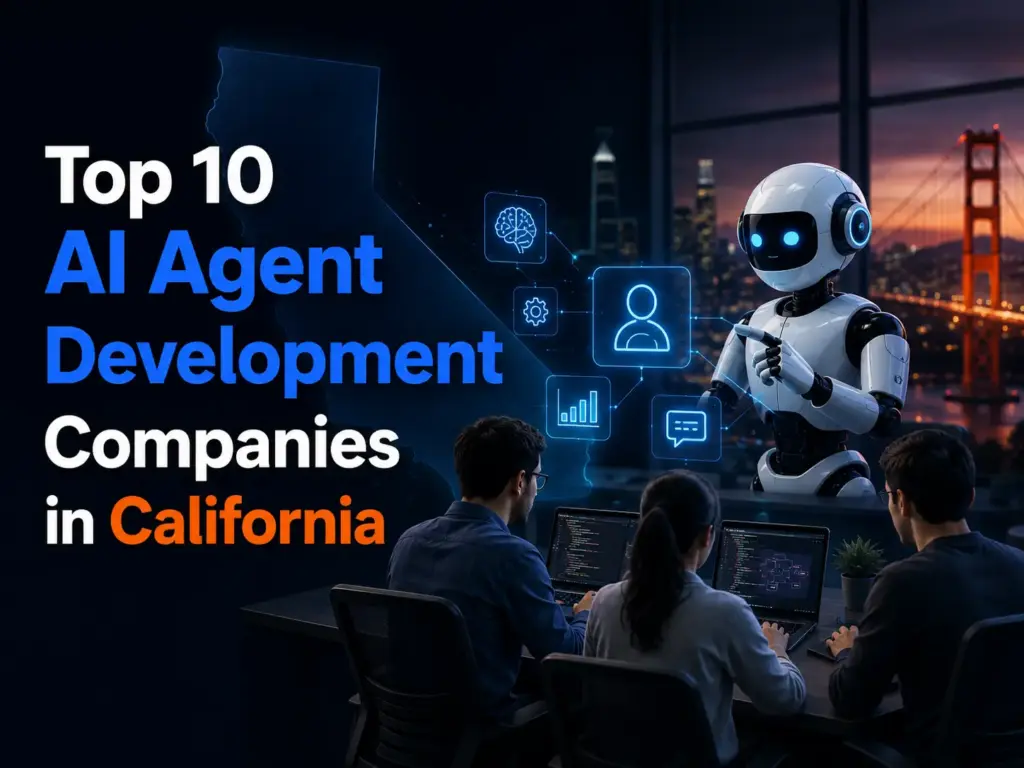
California has always been where technology moves first. From Silicon Valley to Los Angeles, the state is home to some of the most ambitious AI projects in the world. And right now, one of the fastest growing areas within that ecosystem is AI agent development.
AI agents are not just chatbots. A chatbot answers a question when you ask one. An AI agent takes initiative. It monitors systems, identifies what needs to happen, takes action, and reports back without waiting for a human to trigger every step. For businesses, this means real automation of complex workflows, not just scripted responses to preset questions.
The demand for this kind of technology is growing fast. Businesses across California are looking for development partners who can build AI agents that actually work in production, not just in demos. Finding the right company matters because the difference between a well-built agent and a poorly built one is not just performance. It is time, budget, and the risk of building something that needs to be rebuilt from scratch six months after launch.
This guide covers ten AI agent development companies in California worth evaluating, with honest assessments of what each one does well and who they are best suited for.
What to Look for in an AI Agent Development Company
Before getting into the list, it helps to know what actually separates strong AI agent development companies from ones that just use the right words in their marketing.
Genuine technical depth. Building a working AI agent requires expertise in large language models, orchestration frameworks like LangGraph or CrewAI, retrieval-augmented generation, tool integration, and production deployment. Ask for technical examples, not just case studies with vague outcomes.
Integration experience. An AI agent that cannot connect to your existing CRM, database, or business tools is not useful. The best companies have real experience building secure API integrations across a wide range of enterprise systems.
Guardrails and safety practices. AI agents that operate with autonomy need clear boundaries. Strong companies build in human approval checkpoints, audit logging, and fallback behaviors from the start, not as afterthoughts.
Honest timelines and pricing. Companies that agree to everything and then miss deadlines cost more in the long run than companies that ask hard questions at the start. Transparency during the sales process is a reliable preview of transparency during the project.
Post-launch support. An AI agent is not a finished product at launch. Models change, integrations need updating, and edge cases surface over time. Confirm the support model before signing anything.
With those criteria in mind, here are the ten companies worth knowing.
1. Luminoguru – Best AI Agent Development Company in California
Founded: 2014
When it comes to building AI agents that perform reliably in production environments, Luminoguru stands out as one of the strongest development partners available to California businesses.
Luminoguru brings together deep technical expertise in AI architecture with real-world delivery experience across industries including healthcare, fintech, logistics, e-commerce, and enterprise software. What sets them apart from many companies on this list is a clear focus on building agents that actually work under real business conditions, not just in controlled demos. Their approach combines strong engineering fundamentals with genuine product thinking, which means the AI agents they build are designed around business outcomes, not just technical specifications.
Their generative AI development services cover the full range of agentic AI work: multi-agent system design, LLM integration and fine-tuning, retrieval-augmented generation for grounded and accurate outputs, tool orchestration, and secure API connections to existing business systems. They build in guardrails, human approval workflows, and observability from the start rather than treating these as optional extras.
For businesses that need AI agents integrated into mobile or web products, their mobile app development services and software development services mean the entire product can be built and maintained by one accountable team. Their AI development services also cover the machine learning infrastructure that production AI agents depend on: data pipelines, model evaluation, and monitoring systems that catch performance degradation before it affects real users.
For businesses that want to validate an AI agent concept before committing to a full build, their MVP development services provide a structured path from idea to working prototype without burning the full budget before the concept is proven.
Core capabilities:
- Custom AI agent and multi-agent system development
- Generative AI integration and LLM orchestration
- RAG systems for accurate, grounded AI outputs
- Secure API integration with existing business tools
- AI-powered automation across complex workflows
- Post-launch monitoring, maintenance, and improvement
Best suited for: Startups, mid-market businesses, and enterprise teams in California looking for a technically strong AI agent development partner with a genuine track record of building and shipping production AI systems.
Website: luminoguru.com
2. Scale AI
Scale AI is one of the most well-known names in the California AI ecosystem. The company built its reputation on data labeling and annotation infrastructure, which has become foundational to how large AI models are trained and evaluated.
For businesses building AI agents that require high-quality training data or evaluation infrastructure, Scale AI provides the underlying data platform that supports that work. Their enterprise offerings have expanded over time to include AI application development alongside their core data services.
Scale AI is best suited for larger organizations with significant data requirements and the resources to work with an enterprise-tier vendor. For smaller or mid-market businesses, the engagement model and pricing may not be the right fit.
Core capabilities:
- AI data platform and labeling infrastructure
- Enterprise AI application development
- Model evaluation and testing services
- AI deployment and integration support
3. Turing
Turing operates as a platform that connects businesses with vetted AI and software engineers for dedicated team engagements. Their model is built around matching companies with senior developers who have passed a rigorous technical screening process.
For businesses that want to build an internal AI agent capability with experienced external talent, Turing is worth considering. Their engineers work as embedded team members rather than as a managed services vendor, which suits companies that want to maintain direct control over the technical direction.
The tradeoff is that Turing provides talent, not end-to-end delivery accountability. Businesses using this model need internal capacity to manage and coordinate the engineers.
Core capabilities:
- AI and machine learning engineer placement
- Dedicated development team staffing
- LLM and generative AI engineering
- Software development across all major stacks
4. DataRobot
DataRobot focuses on automated machine learning and AI deployment infrastructure. Their platform helps organizations build, deploy, and monitor predictive AI models with a reduced reliance on specialist data science expertise.
For businesses where AI agents need to make predictions based on structured business data, DataRobot’s platform can provide the underlying model infrastructure. Their California presence and enterprise client base make them a relevant option for larger organizations with established data infrastructure looking to add agentic capabilities to existing AI investments.
Core capabilities:
- Automated machine learning platform
- AI model deployment and monitoring
- Predictive AI applications
- Enterprise AI governance and compliance
5. Anyscale
Anyscale is built around Ray, an open-source framework for distributed computing that is widely used in AI and machine learning workloads. Their platform helps companies scale AI training and inference workloads across distributed infrastructure.
For businesses building AI agents that need to process large volumes of data or run inference at scale, Anyscale’s infrastructure platform is relevant. They are a technical infrastructure company rather than a product development company, so they are best suited for organizations with significant internal engineering capacity.
Core capabilities:
- Distributed AI computing infrastructure
- Large-scale LLM training and inference
- Ray framework development and deployment
- AI infrastructure consulting and support
6. Weights and Biases
Weights and Biases provides the MLOps tooling that AI development teams use to track experiments, manage models, and monitor production AI systems. Their platform has become standard infrastructure for many of the engineering teams building AI agents in California.
They are a tools and infrastructure company rather than a services company, so they do not build AI agents for clients. However, businesses evaluating development partners should know that any serious AI agent development company will be using tooling like Weights and Biases to manage their development process. It is a useful signal of engineering maturity.
Core capabilities:
- ML experiment tracking and visualization
- Model registry and versioning
- Production AI monitoring
- LLM evaluation and observability
7. Cohere
Cohere develops enterprise-grade large language models and provides API access to those models for businesses building AI applications. Their focus is on enterprise security, data privacy, and deployment options that allow companies to run models within their own cloud infrastructure.
For businesses in regulated industries where data cannot leave their own environment, Cohere’s private deployment options are meaningful. They work primarily through an API and platform model rather than providing custom development services, so businesses using Cohere typically need their own engineering capability or a development partner to build on top of their models.
Core capabilities:
- Enterprise LLM development and API access
- Private cloud and on-premise model deployment
- Retrieval-augmented generation infrastructure
- Multilingual AI model support
8. Moveworks
Moveworks builds AI agents specifically designed for enterprise IT and HR support automation. Their product helps large organizations automate employee support requests, reducing the volume of tickets that need human resolution.
For enterprise businesses in California looking for an AI agent solution specifically for internal helpdesk and employee support use cases, Moveworks offers a purpose-built product that has been deployed at scale. They are a product company rather than a custom development partner, so businesses with requirements outside their core use case would need to look elsewhere.
Core capabilities:
- Enterprise AI agent for IT support
- HR workflow automation
- Knowledge management and retrieval
- Enterprise system integration for support workflows
9. Samsara
Samsara builds AI-powered fleet and operations management software with a strong presence in California’s logistics and transportation sector. Their platform collects data from vehicles, equipment, and field operations and applies AI to surface insights and automate operational decisions.
For businesses in logistics, construction, or field services looking for AI agent capabilities within an operations management context, Samsara is a relevant name. Like Moveworks, they are a product company focused on specific verticals rather than a custom development partner for general AI agent projects.
Core capabilities:
- AI-powered fleet and operations management
- Real-time data collection from connected assets
- Predictive maintenance and safety applications
- Workflow automation for field operations
10. Vicarious
Vicarious focuses on AI for robotics and physical automation, working primarily in industrial and manufacturing contexts. Their research and engineering work focuses on building AI systems that can perceive and interact with the physical world.
For businesses in manufacturing, industrial automation, or supply chain operations looking for AI capabilities that extend beyond software into physical systems, Vicarious is worth knowing. Their work is more specialized than most enterprise AI agent development and is best suited for organizations with specific robotics or industrial automation requirements.
Core capabilities:
- AI for robotics and physical automation
- Industrial AI applications
- Computer vision and perception systems
- Manufacturing process automation
How to Choose the Right AI Agent Development Partner
The list above covers a range of company types: full-service development partners, infrastructure platforms, product companies, and talent networks. Choosing between them depends on what your business actually needs.
If you need a custom AI agent built for your specific workflows and integrated with your existing systems, you need a full-service development partner with end-to-end delivery accountability. A platform or product company will not give you that, regardless of how capable their underlying technology is.
If you have strong internal engineering capacity and need AI infrastructure to build on top of, platform companies like Anyscale, Cohere, or Weights and Biases are worth evaluating.
If you need a specific point solution for IT support or fleet management, Moveworks or Samsara may be the right fit without requiring any custom development.
For most businesses in California looking to build a custom AI agent that integrates with their existing operations, the evaluation should focus on development partners with proven delivery track records, transparent pricing, and experience in your specific industry or use case.
What Does AI Agent Development Actually Cost?
Costs vary widely depending on the complexity of the agent and the systems it needs to connect with.
A basic AI agent handling a single workflow with limited integration requirements typically costs between $15,000 and $40,000. A production-ready agent with multiple tool integrations, memory systems, guardrails, and a proper admin interface typically runs between $40,000 and $120,000. An enterprise multi-agent system with complex orchestration, compliance tooling, voice interfaces, and deep integration with existing enterprise systems can cost $200,000 or more.
Running costs after launch add between $2,000 and $15,000 per month depending on usage volume, covering model API fees, infrastructure, monitoring, and ongoing maintenance. These need to be in the business case from day one.
Final Thoughts
California has more AI agent development companies than any other state, and that number is growing. The challenge for businesses is not finding options. It is identifying which options have the technical depth, delivery discipline, and honest communication to actually build something that works.
The companies that consistently deliver on AI agent projects share a few things. They ask hard questions at the start rather than agreeing to everything. They build in safety and compliance from the beginning. They treat the post-launch phase as part of the engagement rather than someone else’s problem after handoff.
Luminoguru brings all of those qualities to every project, along with genuine technical depth across the full AI agent development stack. If you are working out what an AI agent could look like for your specific business and workflows, we are ready to work through it with you.
Build Smarter AI Agents For Your Business With LuminoGuru
Frequently Asked Questions
What is an AI agent and how is it different from a chatbot?
A chatbot waits for a user to ask a question and responds. An AI agent monitors systems, identifies what needs to happen, takes action, and completes tasks without needing a human to trigger each step. AI agents can use tools, access external data, make decisions based on context, and operate across multi-step workflows.
How much does AI agent development cost in California?
A focused single-workflow agent typically starts from $15,000 to $40,000. A production-ready agent with multiple integrations and proper safety tooling usually costs between $40,000 and $120,000. Enterprise-grade multi-agent systems with compliance requirements can cost $200,000 or more.
How long does it take to build an AI agent?
A focused pilot can be built and deployed in 8 to 12 weeks. A more comprehensive production system with multiple integrations and compliance requirements typically takes 4 to 6 months.
What frameworks do AI agent development companies use?
Common frameworks include LangChain and LangGraph for agent orchestration, CrewAI for multi-agent coordination, and various vector database solutions for retrieval-augmented generation. The right framework depends on the specific requirements of the agent and the systems it needs to integrate with.
Do I need to be in California to work with a California-based AI agent development company?
No. Most companies on this list work with clients across the US and internationally. The California location matters more for the local talent ecosystem and regulatory familiarity than for geographic proximity to clients.
What industries are using AI agents the most right now?
Technology, financial services, healthcare, logistics, retail, and legal are all seeing significant AI agent adoption. The use cases vary by industry but typically cluster around customer interaction, internal workflow automation, data processing, and operational decision support.